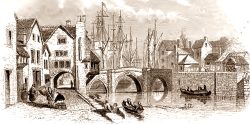
This account on the abandoned 1923 Bridgwater to Watchet (also Bridgwater to Stogursey and Bridgwater to Kilve) Railway has been composed from the notes in the Frederick Allen Collection, with a summary of the earlier failed attempts added.
1882-1883
Following the success of acquiring a Bridgwater to Edington Railway bill that year, a parliamentary bill for a railway line between Bridgwater and Watchet was deposited in the House of Commons in December 1882. This line was to be in two parts, the first being 11 miles long, starting at Wembdon from a junction from the Bridgwater Railway/ Somerset and Dorset line, and finishing at Stogursey. The line would then carry on for 8 miles to St Decumans. The directors were to be the Earl Cavan, P.P Bouverie, J. Robinson, Alfred Peace, Jasper Wilson Johns, Robert Arthur Read, Walter Hawies James and three others (Devon and Somerset News, 28 December 1882). Although it was opposed by the GWR, the bill reached its third reading in the House of Lords, but the men promoting the project informed parliament that they should abandon any further progress in August the following year (Bristol Times and Mirror, 4 July 1883; Taunton Courier and Western Advertiser, 29 August 1883).
1899-1901
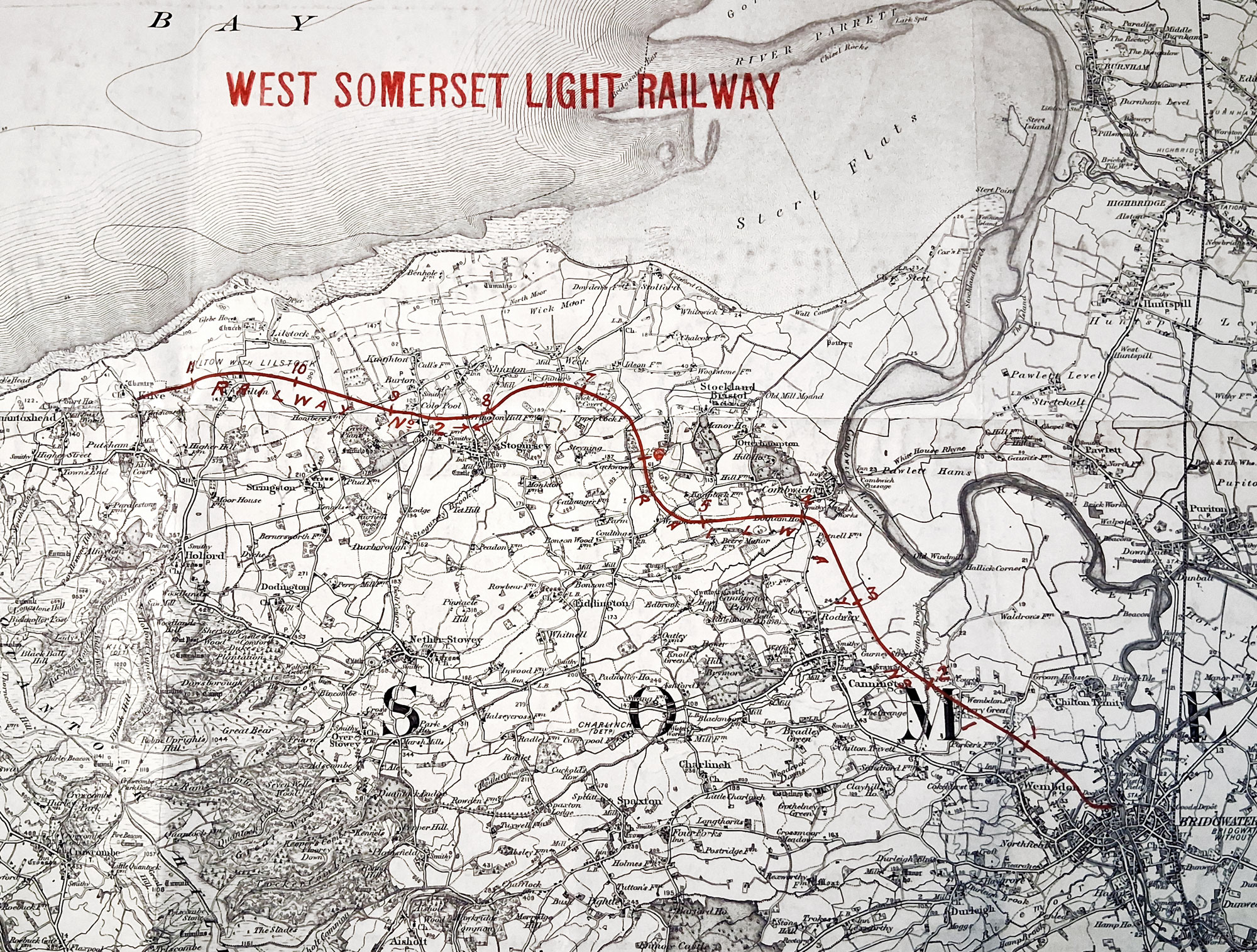
The scheme was revived again in 1899 as a light railway in standard gauge. Again a line would run from Bridgwater to Stogursey in the initial phase, via a tunnel under the River Parrett and would pass through Chilton Trinity, Wembdon, Otterhampton, Cannington, Fiddington, Nether Stowey, Dodington and finally Stogursey. and the committee were H.P. Bouverie, John Morris, Alfred Peace and R.A. Read (West Somerset Free Press, 14 January 1899; Langport & Somerton Herald, 25 November 1899). A year later the scheme was granted approval by the Commissioners of the Light Railway Commission, but no work commenced (Devon and Somerset News, 2 August 1900). The cost of the tunnel under the Parrett was about half the projected cost, and is probably what hobbled the project.
1923-1924
In 1923 the prospect of the railway resurfaced. It was partly envisioned as a means to help tackle unemployment, and partly to capitalise on the prospect of shale oil being extracted along the coastline. Bridgwater Town Council, led by Frederick Allen, seem to have been the prime movers in the effort.
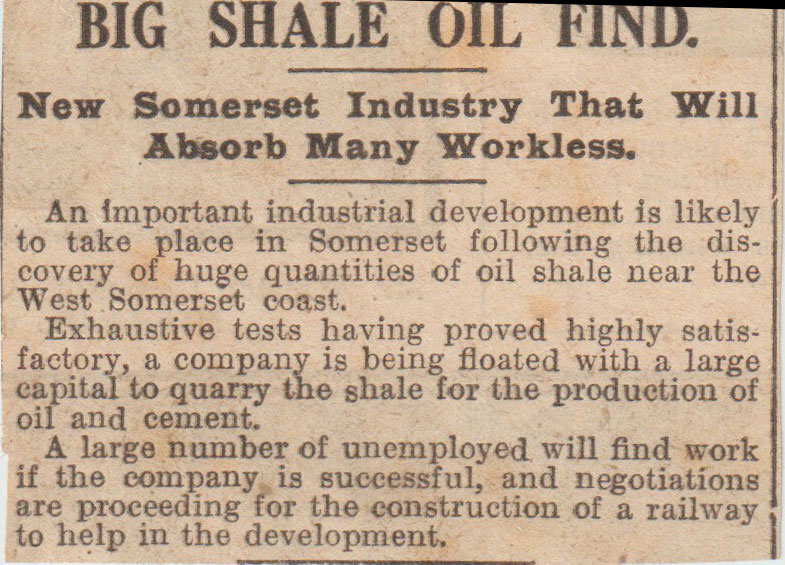
Unlike the previous schemes which had been considered as part of the Bridgwater/Somerset and Dorset Railway, this one looked to partner with the Great Western Railway Company. This is possibly so the Telescopic Bridge over the Parrett might be utilised and a line run from the docks. The first section of this new plan would go from Bridgwater to Combwich, where there it was though shale oil infrastructure would be developed (Langport & Somerton Herald, 16 February 1924). In March 1924 the minister of transport was asked in the House of Commons whether the government would accept the offer from the GWR to jointly undertake the construction. The government declined (Langport & Somerton Herald, 22 March 1924).
Regardless, by June 1924 draft plans and routes were being discussed for the line to go from Bridgwater to Kilve, The line would pass near Manor Farm in Wembdon and through Perry Green, then onto Otterhamton near Bolam Bridge, Combwich, then to Knaplock Road where the parishes of Fiddington, Stockland and Canninton adjoined, then onwards. However, for fears of dangers at level crossing the Bridgwater Rural District Council lodged an objection to the scheme (Taunton Courier and Western Advertiser, 11 June 1924). The project seems to have petered out after this, probably from lack of funding.
Documents
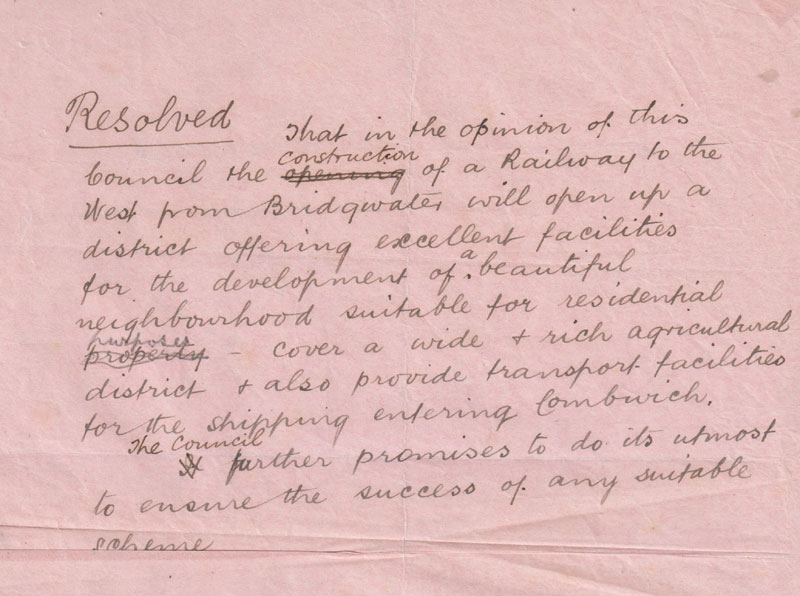
Pink Handwritten Note, clearly from a meeting of the Bridgwater Town Council in 1923:
Resolved: that in the opinion of this council the construction of a Railway to the west from Bridgwater will open up a district offering excellent facilities for the development of a beautiful neighbourhood suitable for residential purposes – cover a wide and rich agricultural district and also provide transport facilities for the shipping entering Combwich. The Council further promises to do its utmost to ensure the success of any suitable scheme.
Map of the Proposed Route
Notes from a GWR meeting, 24 October 1923
Notes of Meeting held at Paddington with Deputation from Bridgwater – October 24th 1923 Suggested Railway – Bridgwater to Watchet
PRESENT:
Mr. Pole
Mr. Williams
Mr. Kline
Alderman F. H. Allen, Mayor of Bridgwater.
Mr. Berry – Bridgwater Town Council.
Mr. Payne
Mr. J. J. Betts
Mr. W. J. Harding
Mr. W. J. King
Mr. A. F. Chapman
(Bridgwater Trades and Labour Council)
Mr. Tolputt – Secretary, Unemployment Conference.
(The General Manager was present during the latter part of the proceedings only.)
ALDERMAN ALLEN introduced the Deputation. He said it was fully representative of all interests in and around Bridgwater and they desired to urge most strongly upon the Company the desirability of undertaking the construction of a railway from Bridgwater to Watchet.
He stated that the Bridgwater Town Council had recently passed a resolution in support of the request and he represented that the present was a very opportune time for the Company to undertake the work in the relief of unemployment in the District. He urged that the area intervening between Bridgwater and the coast was susceptible of considerable development and suggested that any line constructed should be via Combwich, which possesses a natural harbour capable of development so as to accommodate the biggest vessels.
A member of the Deputation asked whether obtaining the 50% grant by the Ministry of Transport would the Great Western Company favourably consider a grant from the Unemployment Grants Committee.
Mr. Pole observed that if the project was approved by the Government his Company would be prepared to discuss the financial arrangements.
It was accordingly agreed:
“That the Deputation would make overtures to the appropriate Government Department requesting approval to the project and a Grant in Aid for Constructional purposes; the Great Western Railway Company to run and maintain such a railway when constructed and, if necessary, to keep separate accounts if desired by the Government.”
Other members of the Deputation spoke in support of the construction of the suggested new line and reference was made to the possibilities of developing the coast resorts for tourist traffic, especially Kilve, which it was urged would make an ideal winter resort.
Further reference was made to the prospects of shale and oil development and of a project on foot for re-afforestation in the neighbourhood of the Quantocks. As to the latter, it was pointed out that a very large and damaging use was made of the roads in the locality in the transport of pit props and other timber to Bridgwater, and that roughly £30,000 had been expended in connection with the maintenance of roads in the district during the last two years.
In reply it was stated on behalf of the Company that, in the opinion of their officers, there was no immediate prospect, at any rate, of such a line proving remunerative. Reference was, however, made to the letter recently addressed to the Minister of Transport by the Company relative to works which they would be prepared to take in hand in the relief of unemployment. This letter, which had been published in the Press, contained an offer to construct a limited number of new lines provided a substantial contribution to the capital cost involved was forthcoming from the Government.
It was recognised by the members of the Deputation that if a line such as proposed were constructed, not only would unemployment in the locality be alleviated, but the use of the roads would be considerably lessened with consequent relief to local taxation.
In these circumstances it was understood that the Local Authorities would approach the Government with a view to the suggested new line from Bridgwater being included in any scheme adopted under the arrangements proposed in the letter to the Minister of Transport already referred to.
As a result of further discussion it was suggested by the railway company that:
“That the Great Western Company would be prepared favourably to consider the construction of the proposed new line from Bridgwater to Watchet or Williton, if, as a result of representations made by the Local Authorities to the Government, financial assistance is forthcoming from the State, similar to that given to Local Authorities for the construction of tramways under the Roads Act, 1920, and to the Nottingham Corporation for improvement of the Trent Navigation.”
[Handwritten addition at the bottom]
A member of the deputation asked whether failing the 50% grant by the ministry of transport, could the Great Western railway company formally consider a grant from the unemployment grants authority.
Mr pole observed that if the project was approved by the government his company could be prepared to discuss the financial arrangements
It was accordingly agreed:
That’s the deputation could make overtures to the appropriate government department requesting approval to the project and a grant in aid for constructional purposes; the Great Western railway company to run and maintain such a railway when constructed and if necessary to keep separate accounts if required by the government.
News Paper Cutting, probably the Bridgwater Mercury. Report dated 2 November 1923
THE PROPOSED BRIDGWATER-WATCHET RAILWAY: SCHEME SUBMITTED TO THE UNEMPLOYMENT GRANTS COMMITTEE
The proposal for constructing a railway from Bridgwater to Watchet is being vigorously pushed forward. As this journal was the first to announce the G.W.R. are quite willing to undertake the work of constructing, linking up Bridgwater with Watchet on the Minehead branch line and to maintain the line, provided Government assistance is given. As our readers will remember the scheme was adopted by a joint conference comprising representatives of the Somerset County Council, Bridgwater Town Council, Rural District Council, Board of Guardians, District Employment Committee, and Trade and Labour Council, of which the then Mayor (Ald. Allen) was chairman and Mr W. A. Tolputt (Ministry of Labour) was the secretary. The conference has made the following submission to the Unemployment Grants Committee, London, for assistance to provide a railway from Bridgwater to Watchet.
DESCRIPTION
- A standard gauge line connecting the existing G.W.R. line at Bridgwater to G.W.R. junction at Watchet, with sidings, stations, etc., to be made as considered necessary by the Company.
REASONS FOR PROPOSAL — UNEMPLOYMENT RELIEF
- The bodies by whom this submission is made have, during the past four years, considered the possibility of providing employment out of public funds for the relief of unemployment.
a. Urged by the various Government Departments the work has assisted in improvements to roads, and although approximately £60,000 has been spent, the grip of the problem only has been touched, and the average percentage of the total insured population under the Unemployment Insurance Act, 1920, has, notwithstanding the real efforts made, remained at not less than 10 per cent for the period. In addition, the work has been thrown back on the Employment Exchanges.
b. Such continued unemployment in a borough containing a total population of 16,000 necessarily involves considerable distress, and the authorities, after mature and protracted discussion, have resolved that, having regard to the particularly attractive avenues which have been permanently closed, amelioration by providing road relief work only, is totally inadequate, easily, and, speaking generally, of no permanent value to the industrial population.
COST OF EXISTING ROADS
- During the past four years the following schemes have been put in operation in connection with road improvement necessitated by the ever increasing traffic, and whilst it may be agreed that fast traffic received minor advantages by the monies disbursed, it is known and recognised that very considerable additional diverting schemes and “costly improvements” will be planned to cope with the exceptionally heavy traffic (e.g., transport of oak, elm trees, bricks, cement, which do not only disorganise the existing roads, but also obstruct the normal fast traffic (motor cars, delivery vans, etc.), which is abnormal, owing to the main road, Bridgwater to Minehead, being the only means for reaching the noted Quantock Hills and coast.
1919-20
Road and bridge programme – £2,770
Long Cross Diversion – 830
Kenchone diversion – 430
Corner improvements and widening – 1,950
1921-22
Bridgwater—Wembdon new road – 20,000
1923
Bridgwater—Wembdon improvement – 700
Pawlett corner – 400
Cannington road improvement – 10,000
Contemplated Bridgwater town improvement to relieve congestion of heavy traffic – 40,000
MAINTENANCE
- In addition to the above disbursements an annual sum averaging £6,000 is being spent on the normal maintenance and upkeep of the existing roads.
PREPARATION OF ROADS TO COPE WITH ANTICIPATION HEAVY TRAFFIC
- The surveyors of the various authorities cited above have given their decision that the existing roads cannot cope with the estimated traffic resulting from the shale mining and cement making by the company which is being floated to exploit the shale which is to be obtained in the district, and further that the cost of making new roads would be absolutely prohibitive and assist the new undertaking only in a very small way. The surveyors state that only a railway can cope with the traffic.
ESTIMATED TRAFFIC — OIL AND CEMENT
- The company which is being formed will, it is understood, have a large capital with representatives of the Continent.
a. The objects of the company will be to deal in (1) petrol, (2) fuel oil, (3) paraffin, (4) lubricating oil and the manufacture of cement.
b. It is further understood the company has extraordinary facilities to produce the oil and cement at phenomenally low prices, and cement at great quantities will be dealt with.
c. For example it is understood that the cost of mixing cement will be about 11s a ton, which is exceedingly lower than existing costs elsewhere.
d. Within 18 months it is anticipated by the company that two refineries will be built — one at Kilve and one at Combwich — and approximately 250,000 tons of material will refer to be transported through the district. After two years the estimate rises to not less than 600,000 tons to be dealt with annually.
e. This oil itself suggests that if fostered the undertaking will afford permanent employment to a large number of men — possibly 600 to 1,000.
f. In addition the port of Combwich must of necessity be developed, adding to the scheme for permanent employment.
AGRICULTURAL PRODUCE
- The districts which the railway line would pass are a particularly rich agricultural area, and the growing of produce is developing on a large scale. For example, during June–July of this year not less than 200,000 bags of peas containing an average of 58 lbs. were picked and transported by lorries at a great cost. With railway facilities it is anticipated this produce will very considerably increase, as the general land and atmospheric conditions provide a very early and satisfactory crop. In addition the growing of wheat, barley, etc., would increase.
PASSENGER TRAFFIC
- Such districts as Stowey, Holford, Kilve, Quantock Hills, and Minehead command an ever increasing number of visitors, and if a railway line was available it is anticipated that the summer tourist would be exceptionally great and the development of oil would also attract additional numbers. The districts are further not subjected to violent changes in atmospheric conditions, and the protection afforded by the hills, together with the sea, make the districts ideal winter resorts.
SUMMARY
- From the foregoing it can be readily seen that the project would materially assist in the development of traffic, thus securing a return to the Railway Company. Once a line was constructed, and above all would secure the industrial development of the areas around Bridgwater, and absorb the numbers unemployed, for whom at present, in addition, the development of the Oil is of paramount importance to this Country as a means of Defence in War time and would make the Country less dependent upon Foreign countries.
GRANT IN AID
- Being confident that the Railway would give the necessary impetus to the ventures mentioned above, the Local Authorities are sanguine that the Unemployment Grants Committee will very favourably consider recommending a Grant in aid, and so abolish the present evil of unemployment which at the moment cannot be removed.
a. As a matter of comparison not less than £30,000 is being spent annually on maintenance of the roads only, and at the rate of estimating £60 per year as the cost of paying a capital sum loan of £1,000 spread over a period of twenty years, it will be observed that the cost of unemployment at present is equivalent to a capital grant of £375,000, a sum in excess of the amount required for the railway. In addition it is suggested that the working of the railway would increase very materially the subsidiary avenues of employment, and thus a greater saving would be assured in addition to a very large sum being contributed weekly towards the Unemployment Insurance Fund.
CONDITIONS OF GRANT IN AID
- It is suggested for consideration that certain conditions should be attached to the granting of any sum in aid, and the following alternatives are submitted for examination:—
(a) The grant be made towards the construction only of the proposed line, the Railway Company to maintain the railway afterwards.
(b) If the undertaking provides a profit, the Railway Company shall return to the Government a proportion amount of the excess over a fair return on capital invested by the Company.
(c) The Government shall consider the possibility of granting to the Oil Company during the development period a proportion of any excess profits made to the Government by the Railway Company.
(d) The Government shall in no wise be responsible for any loss incurred or sustained by the Railway Company or the Oil Company.
Signed:
F. H. ALLEN,
Mayor of Bridgwater.
Chairman, Joint Conference.
Bridgwater, 2nd November, 1923.
THE OIL SHALE FIELD
We have previously referred to the oil shale field and the experimental works at Kilve and discovery of the oil shale by Mr J Berry, a mining engineer, home from South Africa, while on holiday in the district. The shale is prominent feature in the cliffs in the Kilve district, but its commercial possibilities had not been thought of until Mr Berry made his accidental discovery in 1914.
It is said that the shale field extends from Watchet to the river Parrett and runs inland for a considerable distance. It is thought that the shale extends over an area of ten square miles and as the seams are very thick the deposits appear to be enormous. Many mining, geological and chemical experts have made investigations in the district with most satisfactory results and the experimental works at Kilve have given rise to most sanguine anticipations. It is understood that a company is proposed to be formed to deal with the business, with works at Watchet capable of dealing with 1,600 tons of shale per day, and probably at another point. As proposed new railway would serve the oil shale district it will be seen what an important factor this new development will be in the success of the scheme.
Mr Tolpitt gave a demonstration to an “Independent” representative on Thursday, burning a piece of shale and showing the process of extracting the oil. The experiments that have been carried out demonstrate that the crude oil is of a rich dark brown colour, and in the ordinary way took a temperature of 300 degrees to produce the crude oil. By increasing the temperature, lubricating oil, equal to American grade 1 standard, could be obtained. It is understood that forty gallons of oil can be obtained from a ton of shale, and the residue used for various purposes, including the making of cement, and possesses considerable value.
[For more on the shale extraction process, see here].
Letter 16 November 1923
Bridgwater Traders’ Association
To F. H. Allen Esq,
Dear Sir
At a general meeting of the above held on Wednesday last, the members unanimously expressed their appreciation of your effort and the work of your colleagues in the endeavour to get the new railway scheme through and wished me to write you pledging their support and assuring you that they greatly admire your good work
Yours sincerely
Walter Deacon
Honorary Secretary