Although Frederick Allen was president of the Bridgwater Amateur Operatic Society from 1933, few materials saving those below relate to it among his papers. However, he was clearly delighted with the success of H.M.S. Pinafore in 1933, and saved a newspaper report for the performances he was to ill to attend.
Letter 14 October 1921
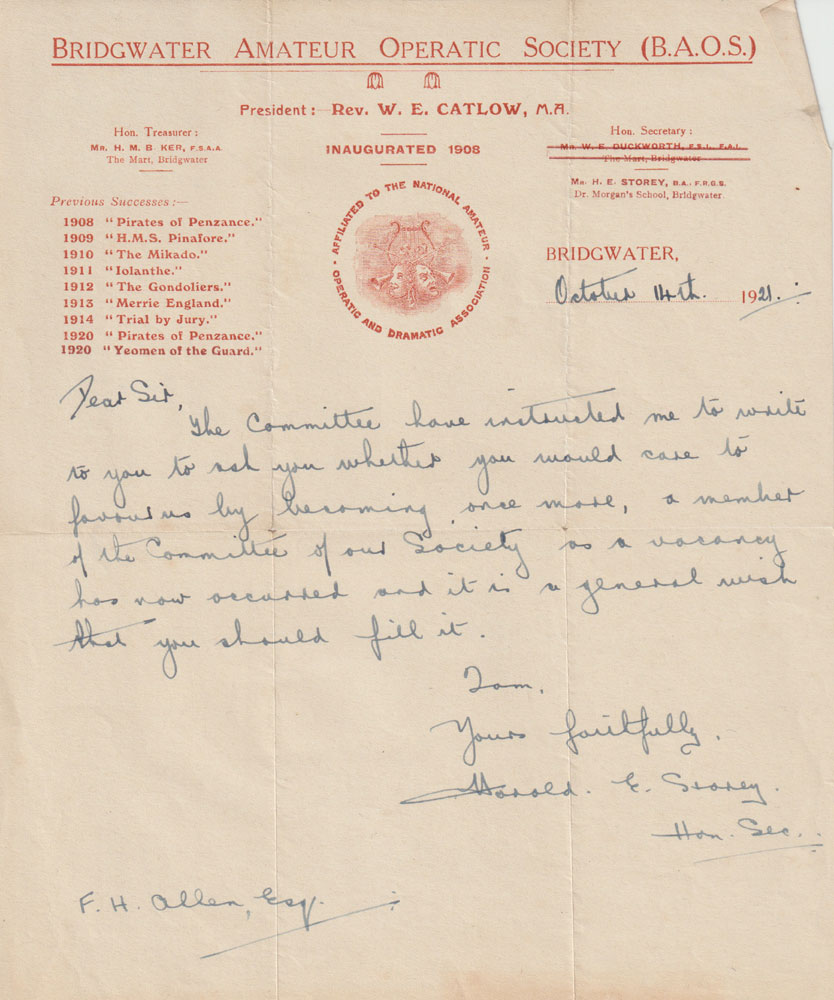
Allen seems to have declined this invitation, but, interestingly, kept this letter.
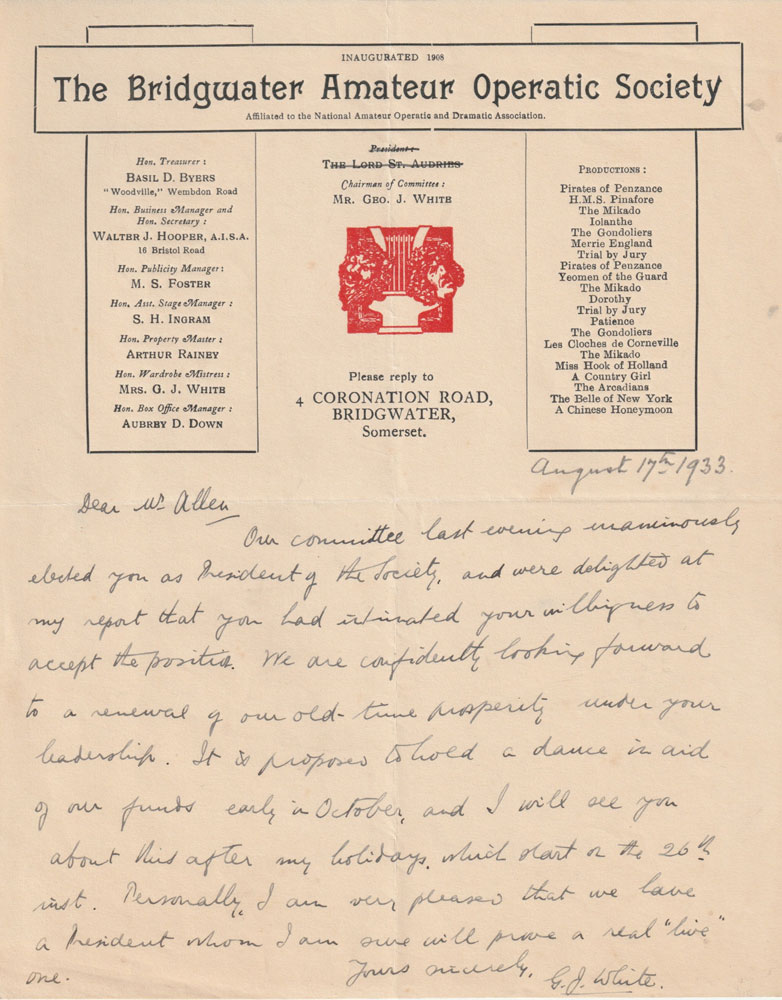
Letter 17 August 1933
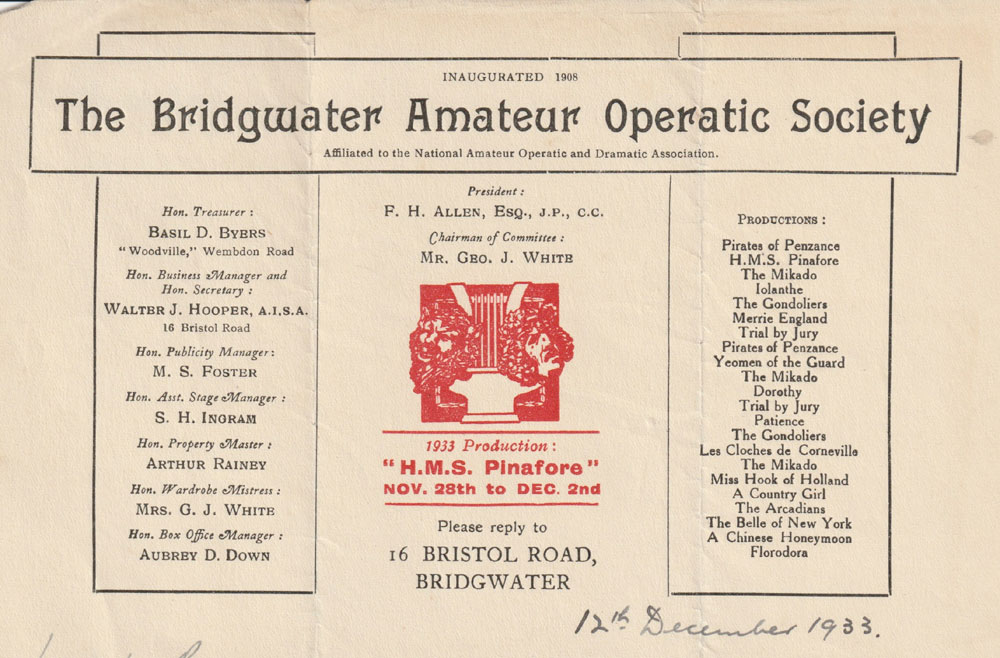
Bridgwater Mercury, 6 December 1933
“H.M.S. PINAFORE” BRIDGWATER AMATEURS’ SUCCESSFUL PRODUCTION
Welcome Return to “G. & S.”, Excellent Performances by Principals and Chorus, Financial Success of Week Assured
That the Bridgwater. Amateur Operatic Society adopted a wise course in returning to comic opera after six years of musical comedy is amply proved by the public support accorded during the run of five evening performances and a matinee on Saturday in the Town Hall last week. The society have had a very anxious period, as, owing to the heavy cost of production, serious losses have been sustained on the series of musical comedies presented since the organisation first embarked on this form of entertainment.
Excellent as were the performances, it was practically impossible, owing to the heavy cost involved., to make them pay in these difficult times of shortness of money and keen competition from the “pictures,” and the society, in reverting to one of the Gilbert and Sullivan operas, not only enabled themselves to put on a show in regard to which there was a reasonable possibility of its being a financial success, but they also afforded delight to the very large body of people who are ever charmed by Sullivan’s delightful music and Gilbert’s clever wit, a combination which has produced a series of comic oprtsd the like of which has never been and probably never will be surpassed.
A BREEZY PIECE
Then, too, the choice of “H.M.S. Pinafore” was a happy one. It is one of the smaller of the series of Savoy operas, and can be produced cheaply, owing to there being little change of dress and none of scenery, while it is a piece full of fascinating musical numbers, with some charming singing and acting for principals and striking ensembles for the full company, with the libretto in Gilbert’s best veil. There is also a plot, although this is story much on the lines of the “story” in most of these operas. Sir Joseph Porter, KCB, a First Lord of the Admiralty, whose knowledge of nautical matters is limited, pays an official visit to “H.M.S. Pinafore,” anchored at Spithead, and is accompanied by his retinue of admiring sisters, cousins, and aunts. The gay old boy as seeking the hand of Josephine, the charming daughter of Captain Corcoran, the commanding officer of the ship, and the captain is naturally delighted at the prospect of gaining the favour of such a distinguished personage. Josephine, however, is in love with Ralph Racicstraw, a “common seaman” on her father’s ship, and Sir Joseph, on learning this, orders Ralph to be placed in a dungeon cell. Then comes the dramatic confession by Little Buttercup, a Portsmouth bum-boat woman, who has come on board to sell her wares to the sailors, that “many years ago” she practised baby farming, and receiving Corcoran and Ralph to nurse mixed them up, with the result that Corcoran was really Ralph and Ralph the captain. This, of course, puts a different complexion on the case from Sir Joseph’s point of view, and he waives his claim to Josephine, who is delighted to become the bride of her real lover, while Sir Joseph consoles himself with Hebe, his first cousin, and the deposed captain falls into the waiting arms of Little Buttercup—”three happy pairs on the same day united.”
SUCCESSFUL OPENING PERFORMANCE.
There was quite a good audience at the opening performance on Tuesday night, including a number of scholars of the secondary and elementary schools of the town, and with splendid bookings for the rest of the week all financial anxiety for the promoters was happily removed. Brilliantly staged—lack of adequate room for the grouping of the full company being the only drawback—and with the ladies attired in the picturesque crinoline dresses, the opera was a feast of beauty, and a striking tribute to the capabilities of the performers and the careful coaching they had received from Mr. W Simms-Bull, of London, who had been engaged as producer. This was Mr. Simms-Bull’s first visit to Bridgwater. He has had wide experience with many of the leading amateur societies in all parts of England and Scotland, and was formerly associated with the D’Oyley Carte Savoy companies. Although he had much new material to deal with, Mr. Simms-Bull worked untiringly, and the result was on Tuesday night an extraordinarily fine performance, a tribute to the skill of the teacher and the perseverance of his pupils. Musically, also, the standard reached was excellent, and to this praise must be given to Mr C E Hobbs, A.R.C.O., the energetic musical director, backed up by the good work of the orchestra.
There was not a hitch to mar the enjoyment of the opening performance. and the enthusiasm displayed by the audience—and not the least by its younger portion—was a testimony to the appreciation of everyone upon a production which will even further enhance the society’s reputation.
THE CAST.
- The Rt. Hon. Sir Joseph Porter, K.C.B. (First Lord of the Admiralty) Headley Haggett
- Captain Corcoran (Commanding H.M.S. Pinafore) Stanley Ingram
- Ralph Rackstraw (Abel Seaman) Basil Byres
- Dick Deadeye (Abel Seaman) W. Oscar Coate
- Bill Bobstay (Boatswain) Darsie Sheppard
- Bob Becket (Boatswain’s Mate) H. G. Clapp
- Torn Tucker (Midshipmite) Fred Baker
- Josephine (The Captain’s Daughter) Vera Roe
- Hebe (Sir Joseph’s First Cousin) Elsie Kirby
- Little Buttercup (Mrs. Cripps, a Portsmouth Bumboat Woman) Marjorie Hooper
Chorus of First Lord’s Sisters, his Cousins, and his Aunts, Sailors, Marines, etc.—Mrs Dorothy Ingram, Mrs. E. A. Stock, Misses W. M. Bryant, G. Burton, M. Chitty, G. Clench, B. Cross, M. Denny, M. Greedy, F. Howe, W. Jones, V. Langdon, E. Neath, M. Parsons, It. Rogers, E. Budge, I. Washer, and V. Woodward; Messrs. F. Baker, R. P. Baker, C. E. Baunton, J. IL Brown, J. Clarke, S. F. Collard, A. Croker, H Hawkings, A. H. Harding, S. Howe, J. H. Hurley, A. Jarvis, F. McMillan, J. M. Pedrick, L II Morgan, A. R. Rendle. Sergeant of Marines, Bugle-Major Fred Wills.
TALENTED LADY PRINCIPALS.
It will be seen that the list of principals is a short one, and the society, from a wealth of excellent talent, had no difficulty in adequately filling the parts. Coming first to the ladies, Miss Vera Roe was the obvious choice for the leading vocal part of Josephine, for it gave her an opportunity of displaying her glorious soprano voice to the full. Her first number, “Sorry her lot who loves too well,” was rendered with artistic feeling, and in striking contrast was the dramatic intensity of her duet with her sailor lover, “Refrain audacious tar,” while her scene in the second act, “The hours creep on apace,” was an even finer effort. She received numerous encores, and took her share well in the concerteds with the other principals and in the finale, also acting with a coyness which was most effective.
Mrs. Walter Hooper, who has scored such triumphs in musical comedy—who will ever forget her as the lovable Nan in “A Country Girl”?—this time had a part totally different to anything she has attempted before, that of the buxom Portsmouth bumbeat woman. The only regret the audience felt was that they had not more opportunities of seeing this clever and versatile lady, who is always such a great favourite, but she agave a perfect representation of a somewhat difficult part. Her acting was as charming and natural as ever; she looked well, and what is more, sang excellently music which was generally considered would be below her range. From her opening number, where she is welcomed on board by the sailors, and sings to them through her scenes with other principals, to her final solo in which she confesses to the “mix up” of Ralph and the captain, she invariably did well, and one of the finest hits of acting seen during the evening was that of her and the Captain in that delightful duet, “Things are seldom what they seem.”
The third lady principal is Hebe, Sir Joseph’s first cousin, a small part but an exceedingly effective one when well done, as it was by Miss Elsie Kirby, who not only made a very pretty figure on the stage, but also acted and sang brightly.
THE FIRST LORD.
Mr. Hedley Haggett was making his first appearance, we believe, with the society in a Gilbert and Sullivan opera, and great as have been his triumphs as the leading comedian. in musical comedy, he has probably never had a part which better suited him than that of Sir Joseph Porter, the First Lord of the Admiralty. He invested the character with just the right touch, an absence of low comedy, but yet bringing out to the full Gilbert’s clever play on , words and the other characterisation of this great humourist and satirist. The popular song, in which Sir Joseph tells how by his strict attention to duties as an articled clerk in a solicitor’s office, and by strenuously avoiding any connection with the sea, he became the ruler of the Queen’s Navee was perfectly sung, and produced the vigorous encore it invariably receives. Mr. Haggett was especially good in the trio, regarded by many as the gem of the opera, ever mind the why and wherefore,”in which Josephine and Corcoran also take part, the First Lord’s eccentric dancing and other amusing antics creating much merriment. The number was encored several times. One hopes to see Mr. Haggett playing many more “G. and S.” parts.
AN OUTSTANDING SUCCESS.
Undoubtedly one of the outstanding successes of the performance was Mr. Stanley Ingram in the part of Captain Corcoran. He made an imposing figure in his naval uniform, as he first appeared on the bridge of his ship, and throughout he gave a fine display, both in singing and acting. This may truthfully be described as Mr. Ingram’s “best part” among the many he has played for the society. He spoke all his lines with clearness and expression, and in his musical numbers his singing was most pleasing, especially in the song where he greets his loyal and devoted crew. He opened the second act with a commendable rendering of a rather trying song, “Fair moon to thee I sing,” and well sustained his share in the concerteds and in the duet with Deadeye, “Kind Captain, I’ve important information.”
Mr. Basil Byers, as the hero, “Ralph Rackstraw,” the able seaman who eventually turns out to be the Captain, gave a delightful impersonation of the part. His acting, especially in the scene where he decides to throw caution to the winds and to declare openly his love for Josephine, was marked by much dramatic intensity, combined with which was a tasteful singing of a number of musical items. The scene, “The nightingale sighed,” and the subsequent air, “A maiden fair to see,” were real gems, and Mr. Byers may be congratulated upon what was one of his best efforts.
Mr. W. Oscar Coate was the detested “Dick Deadeye!’ He looked a sinister figure with his deformed body and shaded eye, and he kept up the part of a discontented and mischief-making member of the crew, singing and acting clearly.
In the character of file more amiable Boatswain, Mr. Darsie Sheppard’s fine bass voice was used with telling effect, and he was encored for his singing of the refrain, “He is an Englishman.”
Mr. H G Clapp was happily placed as the Boatswain’s mate, and these two together with Ralph made a big hit with the trio, supposed to be Sir Joseph’s own composition for the use in the British Navy, “A British tar is a soaring soul,” which had to be repeated.
Master Fred Baker was a perky and pleasing little middy, who strutted about the deck with the pride of a peacock. It was a happy thought on the part of someone to “enlist” as Sergeant of Marines Bugle-Major Fred Wills, who, in addition to his experience in the Territorials enabling him to infuse “life” into the movements of the sentries, gave his words of command. especially during Sir Joseph’s song, with the utmost spirit.
CHORUSES’S EFFECTIVE WORK.
However good the principals may be an opera, or any other musical piece, is impossible without an effective chorus, and the society are to be congratulated upon the high standard achieved by the chorus in the present production. As already indicated, it contained quite a number of new members, but they made up for any lack of experience by a keen enthusiasm, an under Mr Simnis-Bell’s skilful tuition they gave a display which improved as the week progressed. Especially good were the ladies, whose movements were marked by much gracefulness, and their first entrance, as they tripped across the ship, made a charming scene. The men were a merry lot of sailors, and sang with much gusto the cheerful music, well supporting the principals in several of the numbers. The Marines looked well, and gained rounds of applause on each of their appearances. Musically, the chorus might be strengthened with advantage, and once this is done the B.A.O.S. may be able to go on to further triumphs in the realm of comic opera.
A FINE ORCHESTRA.
The specially augmented orchestra, in addition to giving a tasteful accompaniment to the opera, gave two pieces, “Pomp and Circumstance,” No. 1 in D (Elger), and the Overture, “Egmont” (Beethoven), before the overture to “Pinafore.” The latter is considered to be one of the best of the overtures to the “G. and S.” operas, and was most spiritedly played. Mr. Hobbs is to be warmly congratulated on his skilful conducting and his preliminary work as musical director. The instrumentalists, who included four members of the Astral Orchestra, Aldershot, were: First violins, Mr. F. W. Wood (leader), Mr. R. Wood, Mr E Vize; second violins, Mr C C Bird, Mr. A. H. Bell; viola, Miss M. Stenner, A.R.C.O.; violoncello, Mr. A. Bird; double: bass, Mr. H. Novak ; pianoforte, Mrs. M. Fry; flute and piccolo, Mr. J. Harwood; Oboe, Mr L. Treanor; clarinet, Mr. A. V. Shute; bassoon, Mr A. Hay; trumpet, Mr. It. Whitehead; horn, Miss I. Evans; trombone, Mr. H. Viney; tympani and drums, Mr. W. H. Webber.
ZEALOUS OFFICERS.
This year the society elected a new president in succession to Lord St. Audries, who had held the position for several years but desired to retire, and the choice of Mr F H. Allen, J.P., C.C., was a happy one. Mr. Allen has shown a keen interest in the society ever since its inception early in the year 1908, but since the post-war revival he had not taken any active part in the organisation, although each year being a subscriber. Since accepting the presidency Mr. Allen has shown a renewal of interest by attending several rehearsals and by giving a generous contribution to help wipe out the deficit on the funds. To his keen disappointment and that of the members he was unfortunately laid aside by illness, and was unable to be present at any of the performances during the week.
Mr G. J. White continues as the keen and energetic chairman of committee, while Mr. Basil D. Byers has worked with great energy as hon. treasurer. Mr. Walter J. Hooper is the splendid hon. secretary and business manager, and to these two officials much of the credit is due for the admirable arrangements made for the performances. Mr L H. Morgan has been of much use as assistant hon. secretary. Mr. S. H. Ingram as hon. assistant stage manager, and Mr Arthur Rainey as hon. property master, are two more zealous officials. Mrs G. J. White continues to do much useful work for the society, of which she is the hon. property mistress, and Mr M S Foster as hon. publicity manager and Mr. Aubrey D. Down as hon. box office manager have worked nobly, the two latter especially in connection with the booking of seats, a task which has been well undertaken by the staff of Messrs. W. H. Smith and Son’s, Fore-street. Members of the General Committee are Miss Gladys Clench, Miss Vera Roe, Mrs. Pat Harris, Mr H ( Haggett, Mr C C Bird, and Mr It Ai Rowley.
HELPERS. The dresses, wigs, and stage properties were by B. and H. Drury, Ltd., Brighton. The perruquiers were Miss D. Pope and Mr. Henry Ricardo; electric lighting effects by Mr. F. A. Pine, Bridgwater; photographs by Squibbs and Carey, Bridgwater; calls, Miss Ethel Durant; box office stewards, Messrs. P. and M. Pursey; programme sellers, Miss Dyke, Miss H. Roe, Miss B. Body, Miss Evis Airs. Beechey, Miss Jones, Mrs, Kidner, Miss Dowdeswell, Miss Denning, Miss Foster, Miss Willshire, Miss Gaylor, and Miss Keeble. The hall stewards were Messrs. IL Berry, F. G. Berry, J. Butterworth, T. H. Burrow, W. A. Board, R. Beechey W. E. Duckworth, L. E Davies, C. T. Green, T. Greedy, H J. Horsey, C. Hoyel, H P Joy, A. Peerman, C. B. Wood, Ray Buffett, J. H. Palmer, L. G. Baker, F. Thompson, P. J. Tucker, Horsey, G. T. Eveleigh; hon. prompter, r. R. H. Yendole; hon. auditor, Mr. W. S. Growtage.
THE WEEK’S RUN.
There were, as already indicated, splendid huses during the remaining performances, the hall being practically full each evening; the matinee on Saturday the attendance is well up to the average, and at the concluding production there was a crowded audience, who displayed much enthusiasm, several of the more popular numbers, especially the trio, “Never mind the why and wherefore,” being loudly encored. During the week the audience included the Mayor and Mayoress (Alderman and Mrs. Bryer), the Deputy Mayor and Deputy-Mayoress (Ald. and Mrs. F. O. Symons), the members of the Bridgwater Dramatic Club, and the Red Triangle Players, also members of the Taunton and Marlborough Operatic Societies, while on Saturday night a large party brought by Mr. Colin MacKenzie, a vice-president, included Mr. Federick Norton, the composer of the great musical interval “Chu Chin Chow,” who during the nterval came behind the scenes and was introduced to Mr. Simms-Bull, the officers of the society, and a number of the principals. Mr. Norton expressed his delighted surprise at the splendid performance, and extended to all concerned his heartiest congratulations on what he described as “a wonderful show.”
COMPANY AT TEA.
Through the kind generosity of the president (Mr. F. H. Allen, J.P., C.C.). the members of the company, together with the orchestra and the officials of the society, were entertained to tea in the Charter Hall between the afternoon and evening performances. Mr. Allen hoped to have been present, but to the intense disappointment of everyone he failed to put in an appearance, and later a message was received from him stating that the doctor absolutely forbade him to leave his house. In his absence, Mr. G. J. White (the chairman of the committee) presided. It was a happy gathering, with everyone in the best of spirits, well gratified with the success of their efforts. There was a little speech-making, and the Chairman first tendered his thanks and congratulations to the members upon the way in which they had worked together, also eulogising the splendid labours of Mr. Simms-Bull as producer, Mr. C. E. Hobbs as musical director, and the members of the orchestra. Short speeches were also made by Mr. Basil Byers, Mr. Walter Hooper, and Mr. Simms-Bull, the latter of whom made a most interesting, speech, in which he traced the connection of amateurs with the acting profession from early times, pointing out how it was the amateurs who had helped to keep alive the love for acting in the country. To-day, when the stage had to face the fierce competition of the cinemas, it was the great work of the amateur organisations especially the dramatic societies, which was bringing the people of this country back to appreciation of performances of the great plays by living actors and actresses. In regard to their own society in Bridgwater. Mr. Simms-Bull spoke of the great pleasure it had been to him to be associated with them, and in congratulating them on the performance they had given he urged them to be loyal to the society, to try and strengthen it musically. and to show their keen interest, when they started their next production, by being regular and punctual in their attendance at rehearsals.
“A WONDERFUL WEEK.”
At the close of the final performance on Saturday the curtain had to be rung up again and again in response to the enthusiastic acclamations of the audience, and then all the principals walked across the stage in front of the curtain and bowed to their acknowledgments of the cordial respects given them.
Then came the final scene, when Mr White made a short speech. He first re-erred with regret to the absence of Mr F. H. Allen, remarking that they had been as a society keenly looking forward—as he knew Mr. Allen had been also—to his being with them during the week. Mr. Allen, as their new president, had been mast generous, and had shown a keen interest in the society by attending several of the rehearsals, and it was only on the doctor’s orders that he was not there that night. The speaker went on to express the society’s sincere thanks to the public of Bridgwater and the district for the magnificent support they had accorded the society on its return to Gilbert and Sullivan after several years of musical comedy. It was very gratifying to have received that remarkable expression of appreciation of the presentation of one of these delightful operas, and the society had a wonderful week.
When the annual meeting came he anticipated that Mr Byres, their excellent hon. Treasurer, who was known among the members as “the gloomy dean” (laughter) would have a smiling face when he read the statement of accounts (applause). Mr White concluded by publicly expressing his thanks to Mr Simms-Bull for his able coaching of the society, and to Mr Hobbs for his services as conductor and musical director. The orchestra had done magnificently, and was, he considered, the best orchestra they had had in the long history of the society (applause).
Mr. Basil Byers added a few remarks of appreciation of the public support, which he thought would result in a profit being made on this year’s production. (applause).
Mr. Simms-Bull, who had a most cordial reception, returned his sincere thanks to the members of the company for their support during his first visit to Bridgwater, and wished the society every success in the future. (Applause.) The performers and audience joined for singing the National Anthem, and then the curtain came down for the last time.
PRESENTATIONS.
.On the stage followed a number of presentations, personal gifts to the principals au several members of the chorus, consisting largely of boxes of chocolates and cigarettes. There were also a number of presents of a humorous character. Sir Joseph Porter. as “the monarch of the sea,” had a tiny ship. Captain Corcoran a toy guitar, the sergeant of marines a child’s trumpet, and the middy a stick of rock. Great enthusiasm pre-vailed, and finally the whole company joined hands and sang Auld Lang Syne.