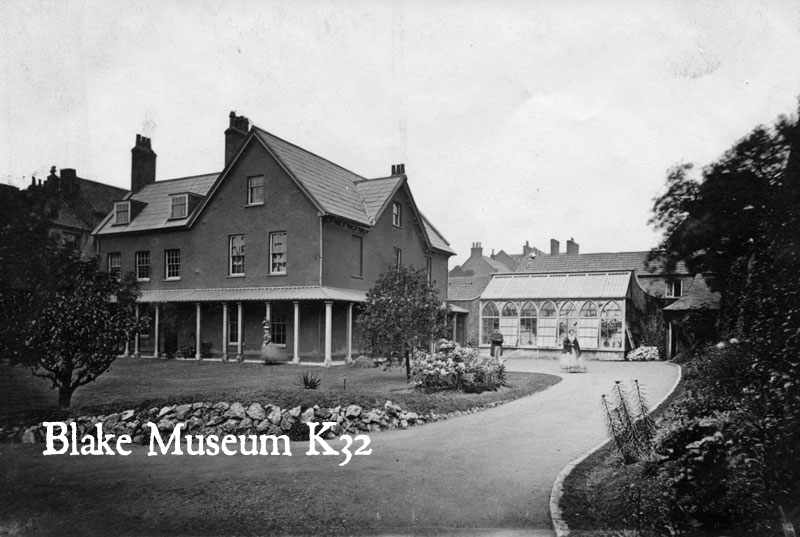
Dampiet House takes its name from Dampiet Street (previously Dampiet Ward), although it adjoins partially fronts George Lane/Street. It is therefore both number 4 Dampiet Street and number 11 George Street.
In the listing particulars for the house, the date is given as c.1830-40, although this is likely wrong. Although certainly remodelled about that time, the core (as given in the Somerset HER) is likely eighteenth century.
The earliest glimpse of the property is hinted at in 1696. Oddly, the wall of the house along George Street appears in the 1835 Borough property report as ‘a spot of ground 17 feet in length and 20 inches in breadth, on which the lessee built the wall of his house towards the street called Dampiet Street, over against the George Inn’. The lessee was Robert Steare of Bridgwater, gentleman, granted on 4 May 1696 for 99 years. Why there was such an odd arrangement is a puzzle. It is likely that Steare had built a new house but too far forward into the roadway and then had to arrange a new lease for the tiny strip of land from the council retroactively.
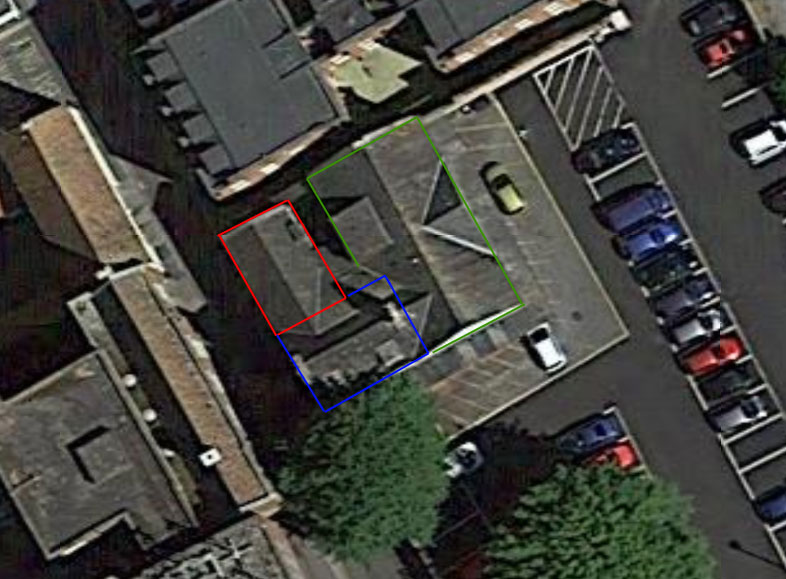
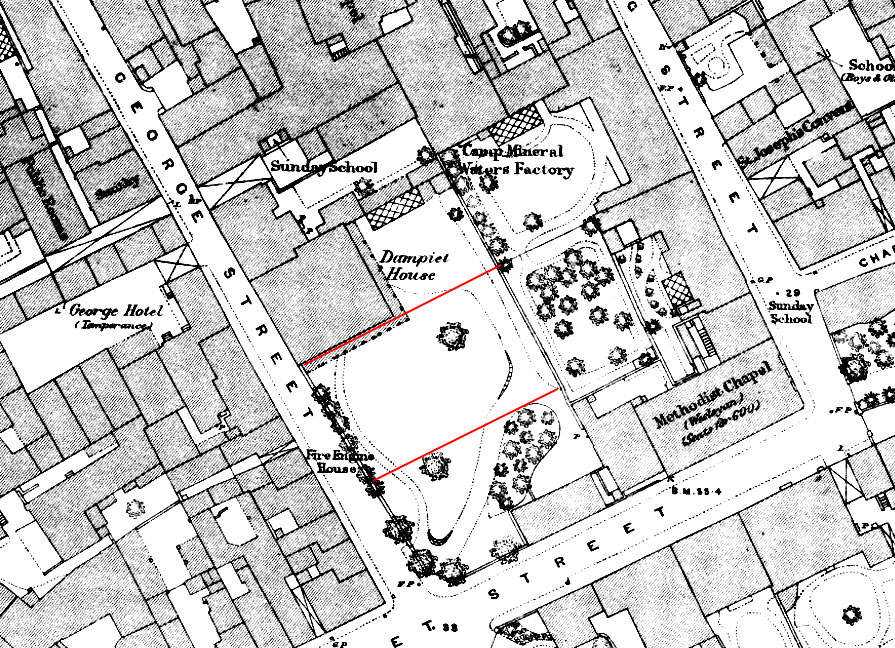
The land on which the house is built consists of three plots. The northern most one has the house. It had taken this form by the 1810s, when it appears on the Town Plan. The same footprint appears on subsequent maps and is the same today.
The house is mention in 1824, but does not yet seem to be known as ‘Dampiet House’. It was described as:
A large commodious and well built dwelling house, forming a desirable residence for a genteel family, with the garden, stable, and coach house siturate in the street called George Lane, in the town of Bridgwater, with two other gardens adjoining. The house is held for the remainder of a term or terms of years absolute, of which several hundred are still unexpiredl and the two Gardens for the residue of a term of 99 years, determinable on the deaths of three lives, aged 57, 35, and 33 years. The premises may be views by applying to Mr John White, who is in the occupation of part of the dwelling house.’.[1]
The 1835 borough report notes that the house was now ‘Mr Wride’s [house] occupied by Miss Rawlins’. Could ‘Wride’ be White mentioned in 1824?
It is unclear who occupied the house in the 1841 census. There does not seem to be a Rawlins listed in Dampiet or George Streets,
By 1851 the house was probably the home of George Henning Pain (1801-1880), a solicitor and notary public, originally from Axbridge, and his large family. In this census, in 1861 and 1871 they are listed in George Lane (George Street in 1871).
We get confirmation that their home is certainly Dampiet House in 1873, when newspapers reported on the marriage of Mary Ann Pain, daughter of George Henning Pain, solicitor of Dampiet House, married to Rev. W. Anthony Cass, the vicar of Burford, Oxfordshire. The officiating vicar was Rev. Montague Pain.[2] Montague is probably the one to place an advert in 1878 stating: ‘Curacy Wanted by an Oxford M.A. in priest’s orders, aged 32, unmarried. Views moderate. No knowledge of music, address ‘Clericus, Dampiet House, Bridgwater’.[3]
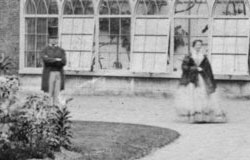
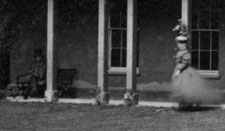
George Henning Pain died 30 October at Dampiet House, aged 80.[4] He was buried in the Wembdon Road Cemetery and Caroline (nee Harding), his widow, had a stained glass window installed in his memory in St Mary’s Church.
Caroline lived on in the house after George’s death. In 1885 she advertised for ‘a trustworthy boy as general servant, about 14 years, who has lived in good service’.[5] That same year Mrs Caroline Pain of Dampiet House was summoned by the local authorities for having a well on her premises which were injurious to health. James Cook, the town clerk prosecuted, while Arthur George Pain (her son), solicitor defended. The case was adjourned – Pain argued the water was pure while Mr Parsons the medical officer indicated decomposition of sewage or organic matter.[6] In 1887 Caroline advertised for a boy ‘about 14, who has knowledge of in door work and can attend to lawn etc’.[7] On 12 January 1892 Caroline, George Henning’s widow died aged 81.[8]
Arthur George Pain moved in to the house, and was resident by 1901. He had married Frances Ward of Gill Head Westmorland, at Great Musgrave in 1881.[9] The 1911 census tells us that Dampiet House had 14 rooms in total (including the kitchen). Their only surviving son, Francis George Henning Pain, a legal clerk was living with them. Arthur George Pain died in the house in 1925. He had been a solicitor since 1864 and had worked in Weston super Mare before coming to Bridgwater. He left a window and son and was buried in the Wembdon Road Cemetery.[10]
In 1932 a Mrs Pain was advertising rooms in Dampiet House: ‘very comfortable home; full board, 30/- weekly; good table, central, garden, garage; large house; 1440 oak staircase’. Rooms seem to have been rented out thereafter: William Davis, labourer mentioned in 1935; William Henry Nurton, labourer in 1938.[11] In the 1935 Whitby Directory, while Pain is at 4 Dampiet Street, a Miss H. Silke is listed at 11a George Street, indicating that the Pains used the Dampiet entrance, while a flat was let out into George Street. However, in the 1937 and 1939 Whitby Directory for Bridgwater only lists F.G.H. Pain at 4 Dampiet Street. No properties are mentioned in George Street.
In 1940 an air raid shelter was set up in the garden, alongside others in the garden of the Priory, and ones in Penel Orlieu and Taunton Road.[12] In 1947 F. G.H Paine attempted to start a hotel at his premises at Dampiet House, although his application for a catering licence was rejected.[13] In 1949 an Edward George Paine of Dampiet House had his wrist watch stolen, showing the Pains still lived at the house.[14]
By 1960 a small shop operated on the ground floor facing George Street.[15] The 1960 Kelly’s Directory lists Palmer and Woolaway carpenters, joiners and cabinet makers in number 4 Dampiet Street (and they were still there in 1967). At 11 George Street was Eric Sellers, and in 11a was D. Davis ‘turf commssn. agt’ in 1960, while in 1967 number 11 was occupied by a ‘Guide and Scout Shop’ and 11a by B. Stone ‘turf commssn. agt’. Noone is listed in number 11a or 4 in the 1973 directory, only the guide and scout shop in number 11.
In 1964 it was suggested that the garden of Dampiet House be temporarily used as a car park.[16] In 1965 there were proposals to demolish Dampiet House and build a multi storey car park on the site, although the residents of the flats in the house objected.[17]
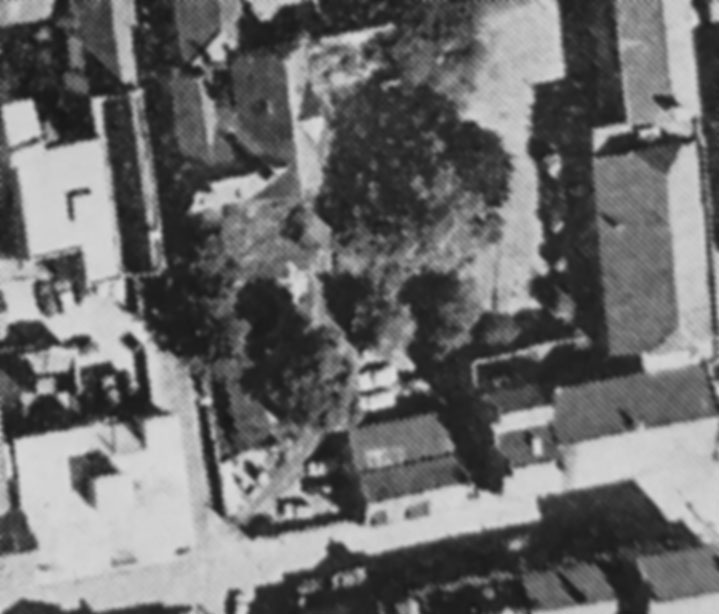
In 1983 Sedgemoor District Council applied to itself for listed building consent to re-roof and re-render the building, and remove the ‘obsolete veranda’.[18] This is probably when the house took the form it does today.
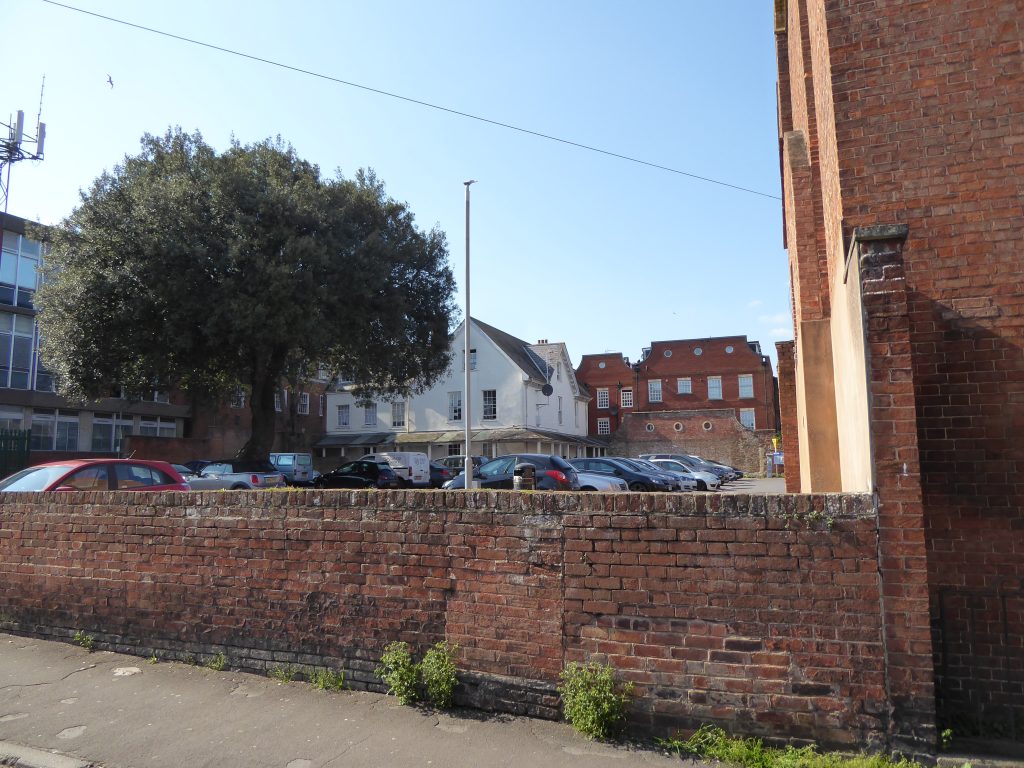
Miles Kerr-Peterson 6 April 2026
Have you seen inside Dampiet House? We’d be keen to know if any original features survive within.
[1] Sherborne Mercury, 15 March 1824.
[2] Bristol Mercury, 1 February 1873.
[3] John Bull, 13 April 1878.
[4] London Evening Standard, 4 November 1880.
[5] Crediton Gazette, 23 May 1885
[6] West Somerset Free Press, 19 September 1885
[7] Devon and Somerset News, 15 September 1887
[8] West Somerset Free Press 23 January 1892
[9] Pall Mall Gazette, 5 August 1881
[10] Langport & Somerton Herald, 31 January 1925
[11] Taunton Courier and Western Advertiser, 20 February 1935; Taunton Courier and Western Advertiser, 22 January 1938.
[12] Taunton Courier and Western Advertiser, 5 October 1940
[13] Taunton Courier and Western Advertiser, 18 October 1947
[14] Taunton Courier and Western Advertiser, 27 November 1948
[15] Bridgwater Journal, 01 February 1986
[16] Taunton Courier and Western Advertiser 9 May 1964
[17] Bristol Evening Post, 22 June 1965
[18] Burnham Gazette and Visitors’ List & Highbridge Advertiser, 19 April 1983