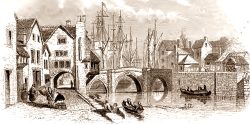
The following extracts from ‘Sketches in Somersetshire’ were serialised in the local newspapers in 1883. The author, who used the pseudonym EREGEN, travelled round Somerset towns, and this provides a charming, portrait of the Bridgwater he saw.
Devon and Somerset News 8 February 1883: Sketches in Somersetshire – Bridgwater – no.1
Most of this first article is omitted, being a recitation of the general history of the town, rather than describing it.
The town at the present day is, considering its antiquity, almost singularly deficient as regards ancient remains. The walls which surrounded it have disappeared. There is not a trace of the four gates which faced the four points of the compass, or of the fifth, which stood at or on the bridge. Of the castle, built by William de Briwere or Brewer in the reign of King John, with walls fifteen feet thick, and covering a large area on the bank of the river just north of the bridge, scarcely a fragment can be recognised, though Mr. George Parker, still living, remembers seeing part of the ruins standing on the site of King’s-square.
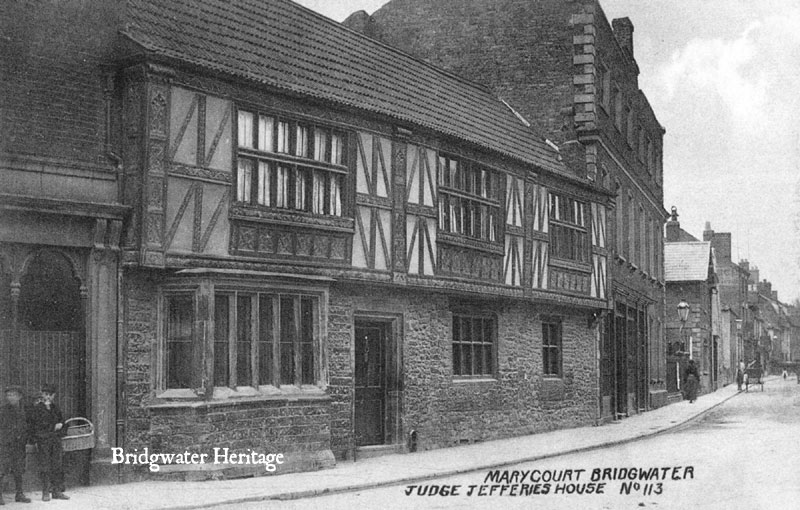
And of the old-fashioned timber houses of the middle-ages there are but two or three examples, and those of small and not very ornate character. The best of them is a house which is pointed out as the one in which Judge Jeffreys lodged, and from the windows of which be witnessed the execution of his victims on Cornhill. Another is the Lamb Inn, a small beetle-browed gabled erection at the top of High-street. The scarcity of really old houses was, no doubt, due to the terrible fire. which prevailed in the town during the siege in 1645.
Devon and Somerset News 15 February 1883: Sketches in Somersetshire – Bridgwater – no.2
The first part of this article, a recitation of the Monmouth Rebellion, is omitted.
Now, let us look at the Bridgwater of today.
Alighting at the railway station, we are quickly within the suburb of Eastover. In 1645 we should have been stopped at a drawbridge, and have been suspiciously examined ere allowed to pass through the East gate. As it is, we wander, with “fancy free,” up long streets of houses, which improve in appearance as we progress. In one window are some rare old engravings. Of course we must stop and examine those; and of course the usual dozen idle boys gather round to see what we are looking at.
In this part of the town stood in old times the Hospital of St. John, founded by William de Briwere, the builder of the castle. Ere long we reach the bridge, and find a host of loungers clustered upon it, and a policeman busily employed in “moving them on.” For the present bridge, erected in 1795 by the Coalbrook Slate Company, is to come down, and preparations are being made for providing a temporary means of communication across the river until a new and more convenient bridge shall be erected. Mr. Moss, the contractor, is superintending the driving of the first piles, and the natives look on with deep interest and satisfaction. Down in the muddy waters of the deeply banked river are a number of ships, and you at once see that the town is a business town, and does a rattling business; too.
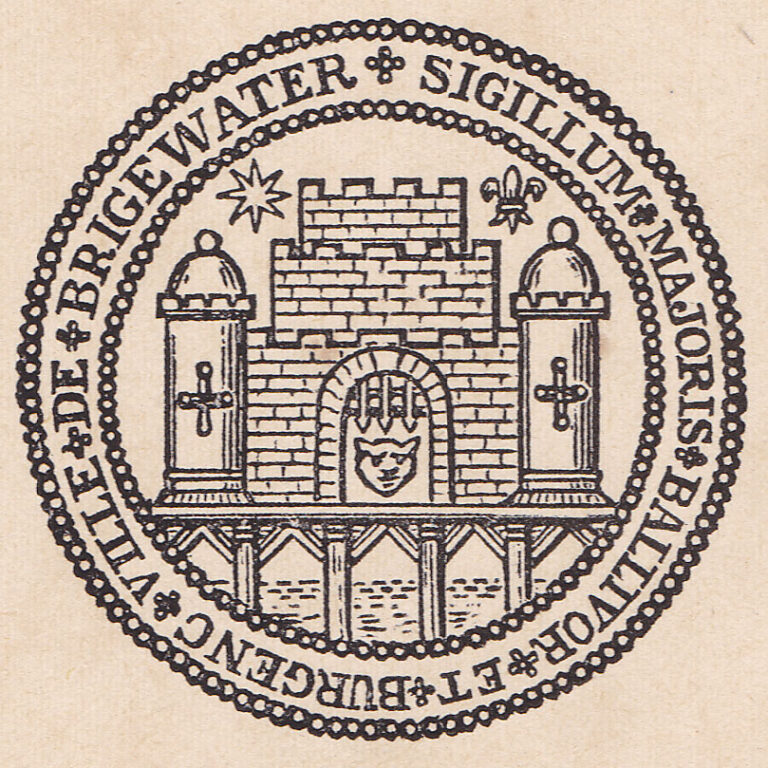
Standing here, on the Eastover side, we can easily conjure up a picture of the place as it was in the early part of the thirteenth century. On the opposite side of the water, on our right, stood the castle, newly erected by William de Briwere. Its position with regard to the bridge exactly agrees with the positions of the castles of Bristol, Chepstow, and Newport (Mon.), etc. There it stood, a colossal mass of tall walls and strong towers, commanding the bridge, and enabling the lord of the castle to levy loll and black mail from everybody who was obliged to cross the bridge with goods or cattle. The old Saxon “brugie” bad been re-placed by a substantial one of three arches, begun by the founder of the castle and finished, it is said, by one Sir Thomas Trivett. On the bank, townside, or perhaps on the bridge itself, stood a massive gate-tower, with a fang-like portcullis hanging down within it; and with apparatus for lowering and raising a draw-bridge which spanned the arch at its foot. There are in the town records several entries of expenses for repairs “of ye houses on ye bruge.” Such an arrangement was by no means unusual. Look at pictures of Old London Bridge, for example. Crafty, exacting and unscrupulous fellows were these old feudal lords. A capital description of their manners and customs is given by the clever authoress of a charming novel, “The Dove in the Eagle’s Nest.” The bridge which existed before De Briwere’s structure was probably composed of strong timber balks, like that in the representation of the town arms at the doors of Mr. Backwell’s stores, nearly opposite the Mercury office. Those arms are gules, a castle, triple-towered, standing upon a bridge, proper; over the dexter tower a star, and over the sinister tower a fleur-de-lis, both or. The bridge was the key-stone of the importance of the ancient settlement, no doubt about it.
We are now in Fore-street, fairly within the town. Here the shops are large and handsome, and have quite a metropolitan appearance. The ground slopes gently upward from the bridge, and the denizens of these parts are safely out of flood’s way. At the top of the eminence is a large triangular space, the Cornhill. Facing us is a handsome building, in the Classic style. In the centre of it is a semi-circular projection, and this is flanked by flat wings. The pillars of the peristyle are lofty and well-proportioned; and beneath them lounge some specimens of those curiosities of humanity which inevitably crop up in every town ; dirty, unshaven fellows, whose only object in life seems to be to keep their hands in their breeches-pocket and yawn, and cause bypassers to wonder whether they get anything to eat, and how they manage to get it, seeing that so many who are hard-working and deserving have enough to do to find employment, and munch their daily bread in anxiety and trouble. One wishes that these unsavoury items were not in the picture. But it is ever so. Beneath the shadow of the glorious cathedral of St. Peter at Rome you meet with no-legged Beppo and his ragged fraternity. In the delirious Bay of Naples there is no escaping from the lolloping Istazoroni, who are almost too lazy to scratch themselves. But they can do that, and beg, too, and, furthermore, be very abusive; and these Bridgwater idlers do none of these things, and that is in their favour.
We are now standing before the facade of the Market-house and on the Cornhill. Here stood the High Cross, where the Duke of Monmouth was proclaimed king, and which was, in after years, turned into a conduit, supplied with water from the Durleigh brook. Here the Duke’s unfortunate followers looked their last of earth and sky, and were dismembered with revolting circumstances, the cruel Judge Jeffreys, looking on from yon window, not only unpitying, but actually gloating with glee over the awful spectacle. And here in our own days are carried out those Fifth of November celebrations which, thoroughly well conducted, perfectly harmless, and intensely picturesque, attract so many hundreds of delighted visitors to Bridgwater every year.
Devon and Somerset News 24 February 1883: Sketches in Somersetshire – Bridgwater – no.3
The interior arrangements of the market house are well suited for the despatch of business with comfort. There cannot possibly be any room for complaint as regards of ventilation; the intrusion of rain and snow is carefully guarded against; the lighting is good. The corn exchange is commodious and nicely-appointed; and the vendors of fish, flesh, and fowl, butter, cheese and vegetables, display their goods in separate corridors.
A Bridgwater market in olden time would have teemed with woollen stuffs. The handsome rollicking Edward the Fourth is generally remembered as a careless fellow, of loose life and conversation; but he was also a generous patron of arts and sciences. Not only did he greatly encourage William Caxton, the introducer of letter-press printing; but, at his invitation, a number of ingenious Flemings came into England, and brought with them improvements in various branches of manufacture. Among these foreigners came the Blanquets (one of whom is supposed to be represented by an effigy in St Stephen’s Church at Bristol), and others, skilled in production of superior woolen goods. They seem to have settled principally in the West of England; were received with great jealously and unkindness by the local tradesmen; and were especially protected by Royal interference on their behalf, the king being able to see much further than some of his subjects as to the course which would most benefit his realm and people. The familiar necessary blanket derives its name from the original makers, who settled at Bristol and Rackway. Only to imagine the comforts of an English winter night before there were no blankets! The name of any clever man from across the sea who set up at Bridgwater is not preserved in the town records, and though there are entries from time to time of payments for freedom to exercise other trades in the town, there seems, according to extracts which have been published, so such payments connected with the woollen trade. This is singular, as the woollen goods turned out of hand here were noted for superior excellence (even long before the Blanquets arrived), were known by the name of the town, and were sent into the market with special directions as to the mode of sale. Inferior imitations were foisted on the public: and consequently, Parliament decreed that “the broadcloth much made in Somerset shall not be sold tied up and rolled, but shall be displayed to the purchaser”. The date of this enactment is given as 1389, reign of Richard 2nd. Perhaps by Royal intervention the early woollen manufacturers were exempted from customary payments for freedom etc. The publication of the full transcript of what Mr Riley, who made search on behalf of the government some years ago, found in the town documents might throw further light on this and other local matters of general interest.
Bridgwater no longer exposes specimens of its staple manufacturers in its own market. Now-a-days its chief productions are bricks, tiles, pottery, and ‘Bath’ bricks (never a one of which was ever made at Bath!); and though these are sent to all parts of the kingdom, you will see none of them in Bridgwater market house. The northern façade of the market house contains the post office.
Immediately beyond the market house stands the parish church, dedicated to St Mary, a large and effective structure, with a tall and slender spire springing from a low square tower of red sandstone. The churchyard gates are kept jealously locked, but public footways run all around the building and allow any one to minutely examine every part of the exterior. The restorers have been busily at work here, and a great deal of what meets the eye is new. The Decorated and Perpendicular styles are somewhat oddly jumbled up together. The east window is Perpendicular, and so are those on the south side of the chancel and south transept. Beyond those, the Decorated style prevails up to the tower. On the northern side of the church the order is reversed. The Perpendicular there prevails in the nave windows, and then in the north transept and north chancel gives place to Decorated.
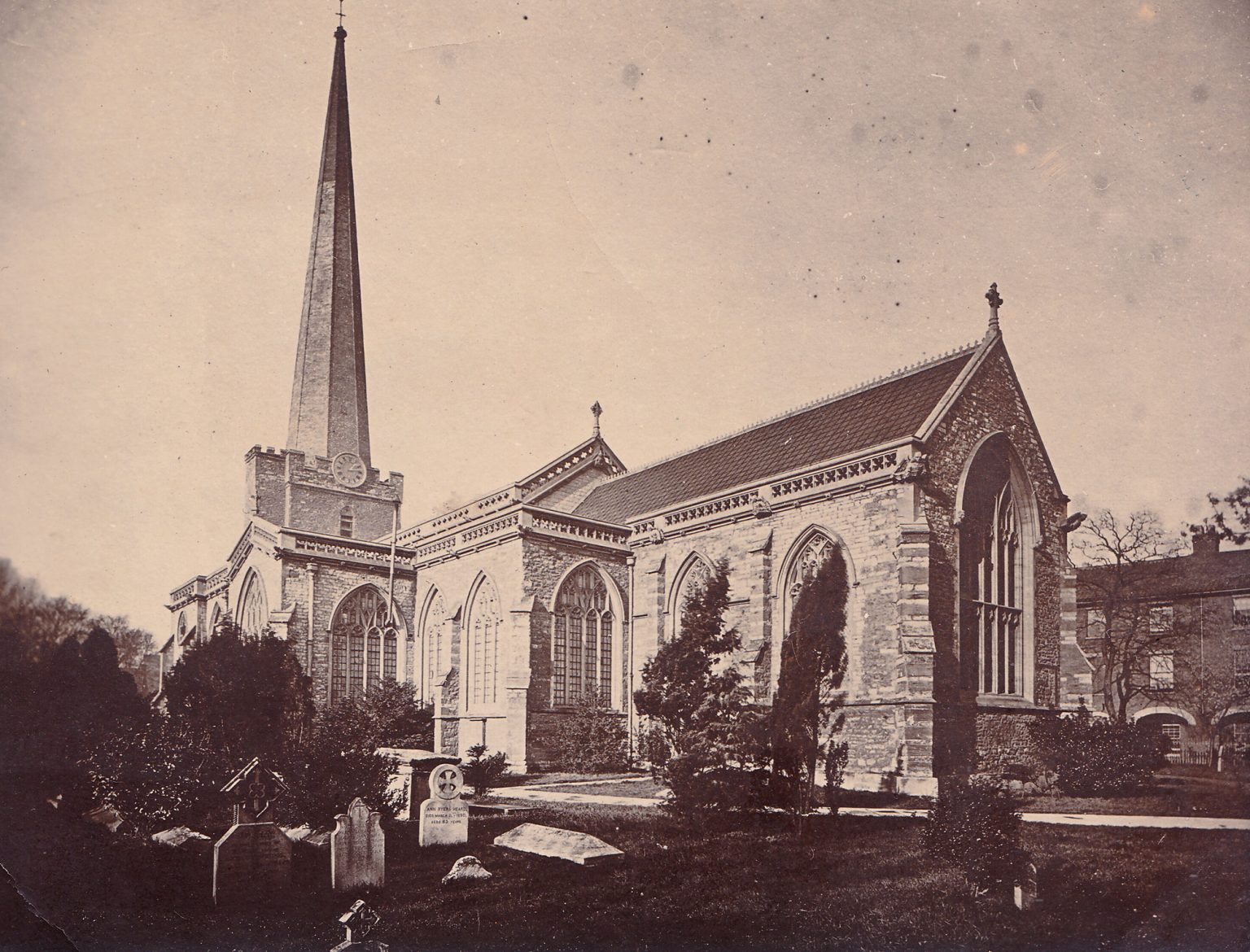
The north porch is enriched with geometric devices and a couple of neiches. Beneath the window of the north transept are two canopied recesses, each of which contains a much-mutilated recumbent figure; and between these a narrow doorway leads down into the crypt. At the north east of the chancel a modern octagonal vestry house has been added.
The window of the south transept contains a series of coats of arms. That in the south porch is what is called a Trinity window, formed of intersecting double triangles within a circle. This porch contains a curious open grating, through which the very wicked people, who in olden times were not allowed to defile the interior of the church, might have the benefit of a peep at the Elevation of the Host at the high altar through ‘squint holes’ which formerly existed in the intervening walls.
The interior effect is very fine, as the church is of unusual width, the roof very lofty, and the pillars which intersect the aisles beautifully light. The rood-screen, which formerly stood, one within the other, in the chancel, have been removed from their original position; and consequently every part of the church commands a full view of the magnificent and renowned painting which serves as an altar piece. The extreme beauty of this composition frequently attracted hither Sir Joshua Reynolds, Haydon, and other artists of celebrity, who studied it minutely. Unfortunately the name of the gifted painter who painted it is not known, and seems never likely to be known. All that is known is that it was purchased at Plymouth by the Hon. Anne Poulet, godson of Queen Anne and presented by him to the church. It is supposed to have been taken from a French or Spanish privateer. Even the nationality of the unknown artist is a matter of conjecture. Some think that he was a Spaniard; others, that he was an Italian. An antiquary who examined it some time ago told Mr George Parker that there was good reason to suppose that the picture was from the hand of Le Soeur (the sculptor who executed the statue of Charles the First at Charing Cross?); but that must be taken for an opinion only, and is of no value.

The drawing, choice of colour, manipulation, and tone, are all faultless. In the foreground lie, extended the dead body of Jesus. The head is raised on the knees of John the Beloved Disciple, and John leans forward, contemplating the Saviour’s face in an ecstasy of love and sorrow. Near the fact of the corpse, Mary, the holy mother, feints in the arms of Mary, the wife of Cleophas; and near the head Mary Magdalene kneels with extended arms. Very large sums have been offered to the Corporation of Bridgwater, who are receivers of the tithes, amounting to about £400 a-year, but they have declined to part with what is unquestionably the greatest ornament of their town.
Visitors to the church will observe that the arch at the west end, leading into the tower, is walled up. This is generally supposed to have been done because the tower without such strengthening was unsafe. Mr. Lockyer, the well-informed pariah clerk, has, however, a different version to give. He says that the all was inserted simply for the purpose of banging thereon the altar-piece, in order to show it to better advantage; that after some time the then vicar, the Rev. — James determined to restore the picture to its original position over the altar; that there was some feeling of opposition among the rate-payers, one or two of whom threatened to riddle the picture with bullets if it were moved over the east; and that Mr. Else consaquently had the picture lined with iron, so that it should not be torn, even shout I any foolish iconoclast indulge his taste for wanton mischief by firing at it. If Mr. Lockyer’s memory be correct, there is no reason why that hideous wall should, not come down at once.
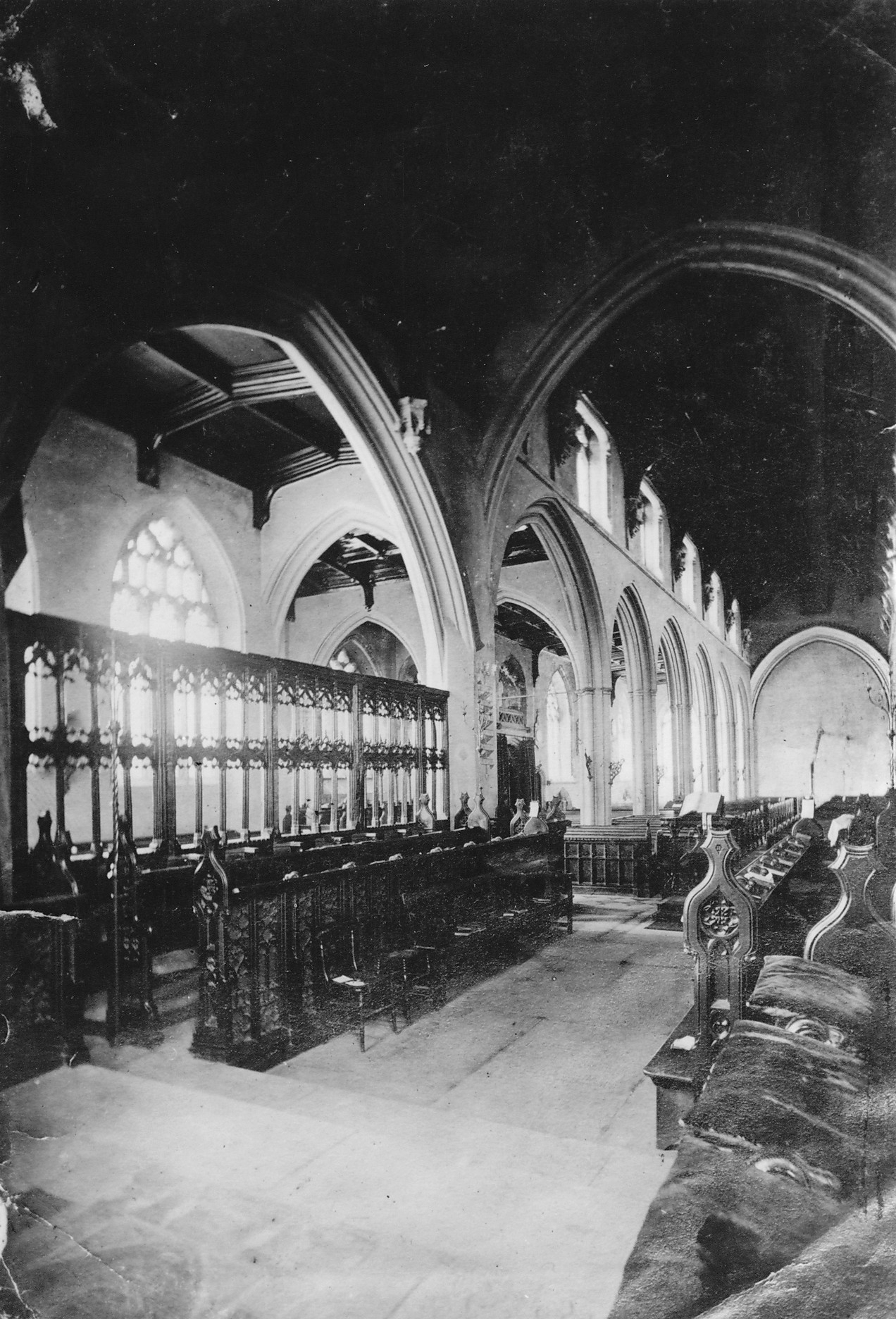
On the north of the chancel is the vestry-room and the organ-chamber, containing the grand organ erected by Willis at a cost of £800. Near the latter is a fine old mural monument representing Sir Francis Kingsmill, who died is 1620, reclining on his left side, his head supported by his left hand, and dressed in the armour of the period. Above him, in niches, kneel effigies of his two sons, in civilian dress.
On the opposite side of the chancel is a niche, containing a piscina and an aumbrey above it. This was for many years walled up, but when discovered was judiciously restored under the detection of the present vicar, the Rev. W. G. Fitzgerald. Great pains were taken with the interior of the building, about 1878, the old whitewash being scraped off the pillars, and other objectionable innovations removed; and the bells were re-hung on the 11th April, 1879. Ranged On each side of the chancel are halves of the earlier rood-screen, a beautiful piece of Perpendicular open panel-work of the 15th century; and the pulpit, of old carved oak, is of similar pattern and age. This screen stood, as usual, at the entrance to the chancel, and was typical of the gates of death, through which it was necessary to pass from the worldly life (represented by the nave) to the more perfect joys of heaven (symbolised by the chancel). Within this rood-screen was set up another, at least 100 years afterwards, in the Tudor style. That also has been removed, and now is to be seen in front of the Corporation chapel on the north-east site of the nave. In the vestry is a picture showing the appearance of both screens in their original positions. Some years ago there was, under the chancel-table, a stone, inlaid with a piece of brass, on which was engraved:
“Though hungry death hath gulped into its maw,
Both sire and child, being first ground in his jaw,
They shall arise when the righteous judge shall say
Arise. ye dead. at the resurrection day.”
At the back of the seats in the Corporation chapel is a good window of painted glass given by Alderman Ford. It contains the town arms and also his own arms .—Azure, three lions rampant, argent. Low down in the wall, on each side of the nave, near the west end, are canopied recesses. in two of which mutilated recumbent effigies remain. Various handsome monuments of modern date appear in diverse parts of the church.
The tower is not remarkably elegant; but one looks at it with more interest than common, remembering how anxiously the Duke of Monmouth toiled up its winding stairs that July Sunday, hard upon two hundred years ago, and looked forth to see how the Royal forces were mustering at Weston-Zoyland. At the south-east corner of the churchyard remains a block of buildings, the removal of which would be a public benefit; but I am informed that the owner asks a sum which the Corporation are not inclined to give, and I do not blame them for looking twice at the public money before spending it. If a fair price could, be agreed upon these old buildings should come down at once.
Devon and Somerset News 1 March 1883: Sketches in Somersetshire – Bridgwater – no.4
Near the south-west end of the church in Silver-street. However attractive it may once have been, it is dirty and shabby enough now. Formerly it led to the Priory of Grey Friars, founded by William de Briwere the younger; and an old doorway which belonged to the establishment is still pointed out.[1] Great havoc was done here by fire at the time of the siege.
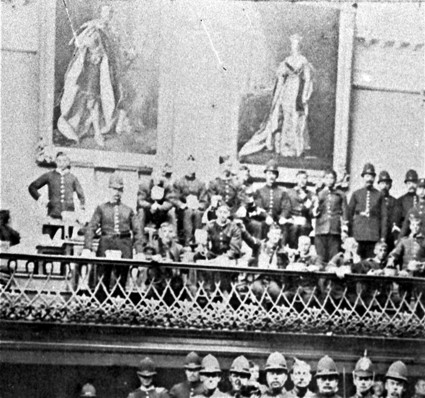
From the church we pass into High-street, and halt before the Town-hall, an extensive building not quite 20 years old. Much ornamentation has not been lavished on the outside; but every visitor should endeavour to gain access to the interior, where there is much that is highly interesting. The large hall (the Old Assize Court) is really a splendid room, one of the best of the kind to be found in the West of England. There is ample space for any purpose for which halls are generally used; and a spacious gallery extends round three sides of it.
Here are three life-size portraits, of great merit, painted by the late Mr. W. Baker, son of Mr. William Baker, currier, of Bridgwater, and brother of Messrs. John and Henry Baker, at present residing here. Two of these portraits, those of Queen Victoria and the late Prince Consort, were, according to brass tablet subjoined, “Copied by permission of Her Most Gracious Majesty from the originals in Windsor Castle by Winterhalter, presented to the borough of Bridgwater, in the year 1865, by John Browne. Esq, when this ball was opened.” The third portrait is that of Alderman Browne himself. and underneath it are the words: “This portrait of John Browne, Esq., J.P., was presented to him during his fifth mayoralty, in the year 1865, by the inhabitants of the town, and given by him to the Corporation to be placed in this hall.”
The Council Chamber, formerly used as the Grand Jury-room, it in an upper story. Here are three noble pieces of tapestry presented by Alderman John Chapman. in 1836. Mr. Chapman resided at Hamp House, on the Taunton-road, now in the occupation of Mr. P. O. H. Reed, solicitor, and he purchased those valuable pieces of antiquity at a large sale at Enmore Castle, since raised to the ground any replaced by Enmore Park House, now occupied by Mr. Thomas Palfrey Broadmead, the present High Sheriff of the County. One of these beautiful masterpieces of the loom represents Alexander the Great saluting his father Philip Fefore mounting the horse Bucephalus; a second represents Alexander the Great throwing his mantle over the slain body of King Darius; the third represents a patriarch surrounded by his family, gazing intently at something not seen by the spectator; but for what this last piece was meant I cannot ascertain.
Over the mantel-piece, between the second and third of these tapestries, are the Royal arms, painted by Mr. W. H. Hawkins, formerly a coachbuilder, of Bridgwater, for the Old Asides Court.
Beneath this is a portrait that must be viewed with pride by every Bridgwater man, for it is that of Admiral Robert Blake, the gallant, true-hearted patriot, who, though he defended Taunton on the Parliamentary side, cared more for the honour of his country than for party strife, and triumphantly maintained England’s greatness. The picture boars the following inscription “The original portrait, by Adrian Hanneman, a pupil of Vandyck, is at Narford Hall, Norfolk, the seat of the Fountaine’s family. Copied by permission by W. Baker for Henry Westropp..Esq., who presented it to the borough of Bridgwater, 1862.”
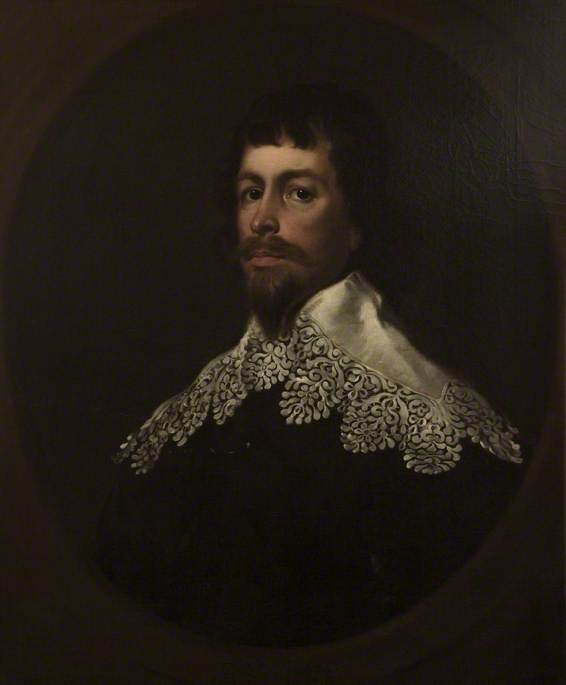
It represents a young man, with moustache and beard, dressed in black velvet, over which falls a broad white collar, edged with lace. Another picture, given by the late Colonel Kemeys-Tynte, M.P., in 1848, is also supposed to represent Blake, in armour, with a skullcap on his head, and one hand resting on a helmet. But this bears not the slightest resemblance to the other, and I am inclined to think that the Colonel was imposed upon if he bought it as a portrait of Admiral Blake. Both pictures differ materially from the spirited portrait by Briggs, preserved at Greenwich hospital. That shows a face full of expression; the eyes particularly clear, bright, and hopeful; moustaches, but no beard and on the left temple a loose love-lock. Mr. J.S. Brown, photographer, High-street, Bridgwater, has just made copies from an exquisite engraving of the Briggs picture, and has also copies of the Hanneman picture. These agree in expression, but otherwise vary considerably. The bust given by Mr. R.A. Kinglake to the towns of Taunton and Weston super Mare most nearly resemble the Briggs picture, but show and older and more care-worn face. The differences are such as to raise the question: Which of these is to be accepted as a genuine likeness of Admiral Blake? That question I am trying to solve.
In this room are a valuable copy of the Portland(?) vase by Wedgwood; a series of beautiful casts from cameos, ancient and modern; and some local views illustrating the Bridgwater of the past. One of these pictures shows an old turnpike gate and toll-house on the Salmon Parade (near Price’s limekiln), and at the back of the picture is a memo extracted from the minutes of the Corporation as Turnpike Trustees, dated 17th July, 1842, as follows :—” Mr. J. W. Wainwright, builder, of Bridgwater, tendered to pull down the old toll-hones, called Salmon-lane gate. and to erect a new toll-house at Redgate for the sum of £50.” Another of these pictures represents the Parret, as seen from Cannington Park in 1745.
In the police-court below is a series of shields of great interest to local historians, as they are blazoned with armorial bearings of families connected with Bridgwater. Here also are painted up full lists of the mayors, aldermen, and other officials of the borough. The publication of the blazon of the shields alluded to may enable some antiquary to identify the families represented; and an interesting chapter may then be made concerning the former lords of this district. The arms on the shields are as follows:
- First, gules, a cross fusilly, or.
- Second, or, on a bend sable, three lions’ heads, erased, of the first.
- Third, sable, a chevron between three lions’ heads, erased, or.
- Fourth, gules, a lion couchant regardant, between six cross-crosslets or; with the canton of a baronet.
- Fifth, or, two bars gules, each charged with three cross-crosslote, fitchee, of the first; in chief, a grey-hound entrant, sable.
- Sixth, or, a fess dancette, sable, charged with three bezants, between three billets, sable, each charged with a lion rampart of the field, Rolls.
- Seventh, sable, three scallops or.
- Eighth, gules, semee of cross-cresslets, fitchee, or, a lion rampant, or; with the canton of a baronet.
- Ninth, gules, three boars’ heads, erased, in fess, or.
- Tenth, blank.
- Eleventh, chequy, azure and or, a bend ermine.
- Twelfth. or, a chevron between three trefoils sable.
- Thirteenth, blank.
- Fourteenth, or, a chevron, between three garbs, sable.
- Fifteenth, gules, ten bezants, 4. 3, 2, and 1; with a canton ermine.
- Sixteenth, berry of six, azure and or, a canton argent; on a chief of the 1st, two pallets between two gyrons of the 2nd, Mortimer.
- Seventeenth, or, three bulls’ heads affronte, gules.
- Eighteenth, sable, three hunting horns (huchettes), or.
- Nineteenth. sable, three swords, their points in pile, hilted and pommelled or, Poulett.
- Twentieth, or, on a chief dancettee, gules, three cross as pattee, or; surmounted with an earl’s coronet.
- Twenty – one, quarterly. first and fourth sable, second and third or; in first quarter a lion passant, or.
At the end of High-street is another open space, known as Pig Cross. Here is the cattle-market, excellently appointed. Thence runs West-street, along which are iron fences with rings attached, and this is the site of the sheep-market. Beyond this is the turnpike-road to Enmore, &c., a road of the most picturesque and agreeable character, and commanding views of the richly variegated Quantock Hills.
Returning into town we find ourselves at the site of the North Gate, where such hot work was carried on at the siege of 1645. The gate has disappeared; and in its place stand a school and a few pleasant villas.
As we pass eastwards, the character of the houses soon deteriorates, and squalor succeeds refinement. On one side of the road is a high red wall, enclosing “Browne’s Yard,” and opposite to it is the Union workhouse. At the end of Browne’s Yard rises an immense funnel-shaped brick building. This is Browne’s pottery. By and by we see other similarly-shaped kilns. As before stated, the principal products of the district are bricks, tiles, draining-pipes, and pottery; and chief among the firms which carry on these businesses are Messrs. Browne and Co., Messrs. Colthurst, Symons and Co., and Messrs. H. J. and C. Major.
A little further on, and the docks, filled with vessels and flanked with stately warehouses rising beside them, attest a vigorous and flourishing trade. That may easily to said of any place that one may wish to compliment, but in this instance the assertion is fully borne out by “facts and figures.” ” The number of vessels which arrived at the port of Bridgwater in 1881 was 3,664, having a tonnage of 204,029 tons.” In the same year no less than 306,160 tons of South Wales coal, besides other produce, was brought hither by sea, and thence distributed over the district. That proves the extensive nature of the traffic. Well done, Bridgwater! Go on, “and more power to your elbow!”
While looking down into the turbid waters, a gentleman who kindly accompanies me points to the mud, and remarks that “that is one of the secrets of Bridgwater’s greatness.” “Very glad to get rid of it, I should think,” I innocently remark. My friend is so tickled with my absurd ignorance that he fairly laughs outright. “Get rid of it; and so we do, and a very good thing we make of it. There is some-thing almost miraculous about it. As fast as. it is scooped up, a fresh supply is deposited; it never fails, and is constantly in demand. Commonplace as that slimy stuff looks, it is of very unusual character: A mile or two up the river, or a mile or two down, you will find no trace of it. Mud, ordinary mud, of course, you will see in abundance; but this sort of thing is peculiar to the town of Bridgwater. You have heard of Bath bricks, I suppose, that they sell in the shops for scouring and other purposes. Of course you have! Well, there was never a Bath brick but it was made of that sort of mud and at Bridgwater; and there never will be!” ” Then why do folk call them Bath bricks?” ” Because they resemble the Bath stone in colour, I expect and for no other reason.” Corrected and instructed, I am abashed and quiet, and pursue my way in silence.
Then we come to a bridge. “The Telescopic Bridge,” exclaims my friend, “This belongs to the Great Western Company. They purchased the docks, end made this bridge to connect the docks with their main line. Look, there is the line of metals behind you.” So it was. Ah, think I; a very nice picking the Great Western Company have no doubt made out of Bridgwater. “I believe so”, says my conductor, “and it would be all the better for them had they felt inclined to make such concessions as the townsfolk thought desirable. For now they will be deprived of the monopoly which they have enjoyed for so many years. Two new lines of railway are in contemplation; and these must materially and beneficially influence the trade of the district. Already there is more goods traffic at Bridgwater than at any other place west of Bristol. One of the projected undertakings, known as the Bridgwater Railway, will extend from the town to Edington, on the Somerset and Dorset line and thus place us in direct communication with the Midland and South Western systems. For this the great bulk of the required capital has been already subscribed, and the holders of South Western stock have very strongly encouraged the enterprise. Thus, on the eastern side, we shall be placed in capital position. Then, on the western side, a new line from Bridgwater to Watchet is applied for. This is protested by an independent company, for whom Messrs. Wells, Owen, and Elwes, of Westminster Chambers, are engineers. This is likely to be strenuously opposed by the Greet Western Company; but there is no doubt that the general feeling throughout the district is greatly in its favour. Such tine cannot be otherwise than a great boon; for it will do away with the present inconvenience of having to go all the way round to Taunton to get to Watchet, and a large increase of trade may be expected.
Across the water I see the tower of another church. That, I find, is a modern erection, set up in Eastover, and dedicated to St. John. There is also a now mission church, dedicated to All Saints; and for this the incumbent, the Rev, F. Seale, is just now inviting contributions to enable him to clear off a debt. Another modern church, dedicated to Holy Trinity stands on the Taunton road, and of that the Rev. G. Trevor is incumbent.
We have now once more nearly approached the bridge, and are in the precincts of the vanished castle. A quiet street of private houses leads up to King-square, where the principal part of the castle formerly stood. Three sides of the square are now occupied by tasteful houses; the centre is occupied by a garden, to which trees and flowers lend eye-refreshing beauty, and, were it not for the incessant chorus of chirruping sparrows, there would not be a more peaceful and quiet spot on earth. At the north-west corner are the offices of Messrs. Reed and Cook, solicitors. Mr. George Parker, the local historian, says that when ten years old (77 years ago), he went to a classical school at the top of Castle-street, kept by a Dr. Jenkins, before any houses in the square were built; that the whole of the square was at that time surrounded with wooden pailing; that the interior was used as a playground; and that there were some large pits, from which, it was understood, the foundations of the old castle had been dug. The only remains now existing of the castle are some walls near the Custom-house on the Western quay, now encircling a bonded cellar. When in its prime it was surrounded with forty guns. Mr. Parker remembers a large open ditch, then called the Bailey Ditch, originally 30 feet wide and of great depth, extending from the bottom of West-street along Mount-street, and through North-gate to the river. This was undoubtedly part of the moat which gave so much trouble to Fairfax and Cromwell. It was some years ago condemned as a nuisance, and filled up, and a great deal of it has since been covered with buildings. Three of the town gateways have been removed within Mr. Parker’s remembrance.
Devon and Somerset News 8 March 1883: Sketches in Somersetshire – Bridgwater – no.5
The house that, above all others, must attract the attention of visitors to Bridgwater, in the bourse in which Admiral Blake was born. It is situate in a small street which appropriately bears the name of the hero; and adjoins a mill in which business is still carried on and which is supposed to have been in operation ever since the days of William the Conqueror, as it is mentioned in the earliest records of the town. Those who expect to find the hero’s birth-place a picturesque, tumbling-down, gimlet concoction of gable-ends and bow-windows and projecting upper storeys will be disappointed. One may reasonably suppose that in the course of time the exterior of the building has undergone alterations that have materially changed its appearance. It is now a plain, smooth-faced, comfortable-looking house, the doorway, sheltered by projection and flanked by sash-windows, those on the ground-floor reaching to the floor.
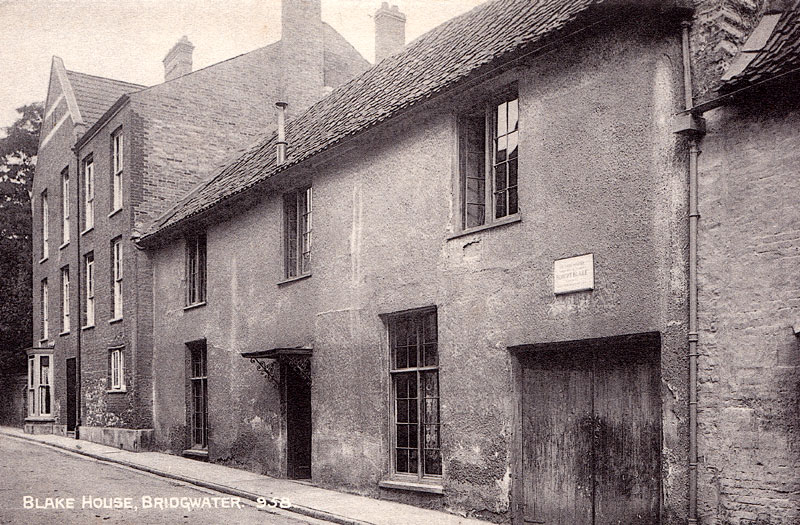
And it is now fitly occupied by a gentleman of all others most fitted to dwell in it, Mr. George Parker, the venerable local historian. It was purchased by him from Mr. Uttermere, of Langport. Mr. Parker has attained the ripe old age of 87 years, and time has, of course, robbed him considerably of his vigour. We were fortunate enough to find him at home, and be most courteously showed us over the premises. The antiquity of the interior is attested by the low ceilings, intersected by massive beams, the spaces between which are dotted with rosette ornaments, and there is an old fireplace with boldly developed mouldings.
Mr. Parker kindly showed us the remains of the old kitchen also the traces of its huge fireplace, the Gothic two-light window beside it, and other details of domestic arrangement. But, notwithstanding descriptions by other writers, there are no shields. Did these exist, they would be particularly valuable as attestations of the families who occupied the premises in years gone by. A century before Blake’s time it was the fashion, as described by Montaigne, to set up armorial hearings as lasting memorials of proprietorship or of the visits et distinguished persons. I have no doubt that that practice led to the use of signs at public-houses. When a great man, usually attended by his large retinue in the middle ages, arrived in a town, his shield would be exhibited over the door of the house in which he sojourned, and became a rallying point easily and unmistakably recognised by his followers. This gives a clue to the origin of the Lions, and Swans, and Bears, and Three Cocks, and Three Cups, and so forth, that am now so. plentiful; and raises the commonplace and other who incomprehensible sign- boards into the region of romance and doughty deeds. The “gentle science” of heraldry was still, in the seventeenth century, regarded as an important part of the education of every gentleman; and toeach of the 59 signatures on the death warrant of King Charles the First is added a seal blazoned with armorial bearings of the writer. Levelling as the Commonwealth aimed to be, it did not extinguish pride of ancestry; and the family shields continued to be ostentatiously paraded by all who were privileged to own such. I am not sufficiently versed in local genealogy to say whether the father of Robert Blake wasentitled to write “armiger” after his name.
Sitting where Blake used to sit, we enjoy a conversation with Mr. Parker, who, drawing from the treasury of his well-stored memory, favours us with the following acceptable information :-
“In very early times when it was somewhat doubtful as to the form of Government, whether Republicanism or Royalty should prevail, Bridgwater seems to have been a town of some note and consequence in the West of England, anti its inhabitants were inclined towards Royalty. The Crown owned considerable property in its vicinity. The King’s Park, at North Petherton, was often a scene far the sport of the nobility in hunting scenes—so it continued down to 1645, when the struggle took place between the Royal and Parliamentary armies, the former commanded by Lord Goring, the latter by Sir Thomas Fairfax. The victory gained at Langport by the Parliamentary army led to the siege and storming of Bridgwater. The whole country was at that time in the power of the King. Charles, by letters patent, bearing data 1625 granted to ‘Wm. Whitmore and Geo Whitmore, Esq, the Manor and Castle of Bridgwater. TheWhitmores sold the Manor of Bridgwater Castle and Manor of Haygrove, etc. to Henry Harvey. of Bridgwater. The Castle, which fell to hisdescendants, was leased to Edward Wyndham, the King’s Governor, 1645, two years before the siege. Ihave said that at time the whole of the country was in possession of the King. There was an exception, Taunton, which was defended by Blake. The Castle of Bridgwater was particularly strong, being surrounded by a wide ditch of 30 feet. It was also strongly fortified—Bridgwater was then thought to be of great importance to the west—as the blocking up of that town would lead to impediment to business of all sorts.
In the neighbourhood of Bridgwater, on the way to Knowle, there is a field running to a corner before you come to Bradney Lane. There was an elm which stood when I was a boy, called Watch Elm, to mark the spot where the Bridgwater people met the country people at the time of the Great Plague to buy market commodities. When one elm died another was planted. I fear there is not one now.
The towers of Westonzoyland and North Petherton are of considerable beauty. Freeman says that the towers of Somerset are considered to maintain supremacy over all others in the country. Many little particulars may be gained by my little work, the Ancient History of Bridgwater. The tides, called formerly the Eager, are very peculiar, and furnish considerable value both to town and country. Pawlett lays about 5 miles from Bridgwater. There, towards the river, are the famous grounds called Pawlett Hams the richest grazing grounds in the country. The ploughed ground is often very productive around Bridgwater. There is a large piece of ground at North Petherton Park estate; it was about 50 acres in extent in ply early day, and they say it yielded 50 bushels of wheat an acre, when wheat was sold at 20s. and a guinea a bushel.”
The rest of the article omitted as an account of the life of Robert Blake.
[1] This garbles the 18th century ‘Priory’ house with the Friary which stood near Friarn Lawn. The door in Silver Street is certainly old, it may be salvage from the Friary, although it could just be a grand house. MKP.