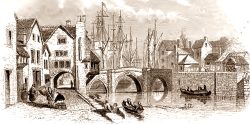
The below account of the unveiling of the Blake Statue is perhaps the best expression of its construction and symbolism.
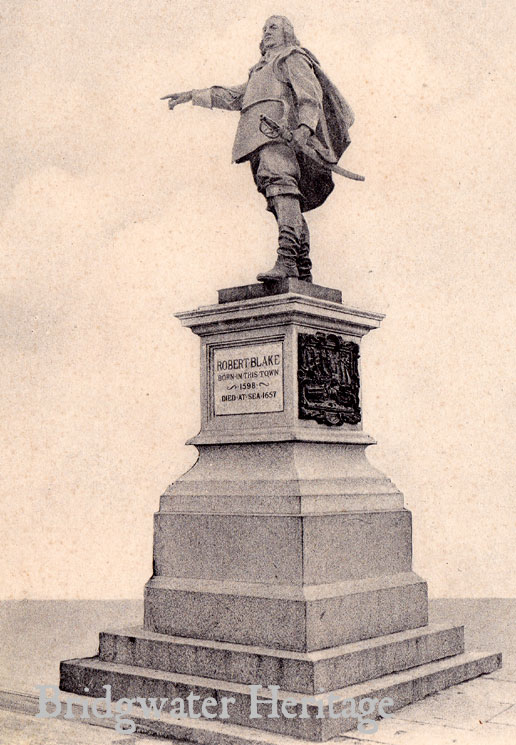
Western Daily Press, 5 October 1900
THE BLAKE STATUE AT BRIDGWATER.
UNVEILING BY LORD BRASSEY.
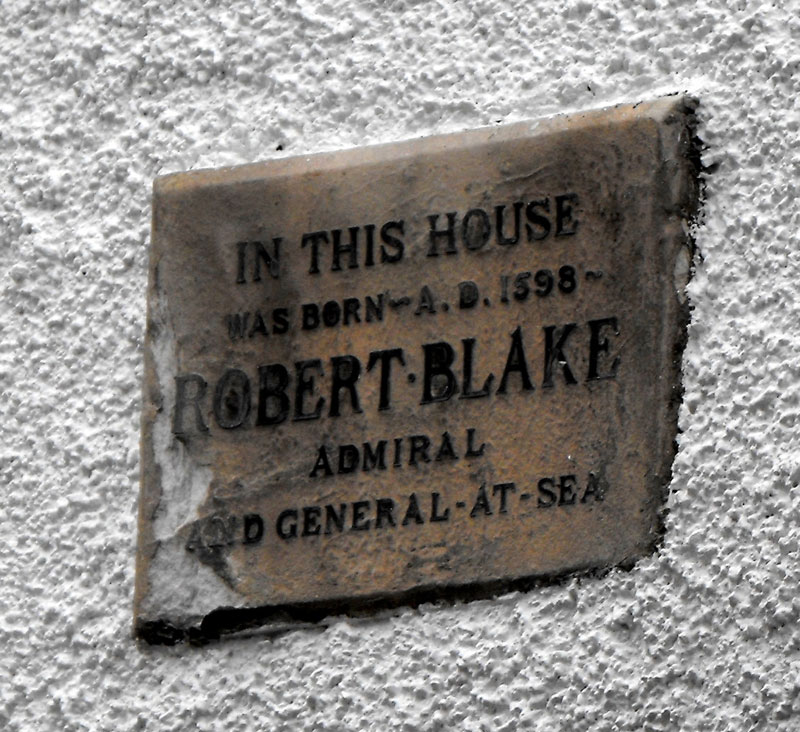
There were great rejoicings at Bridgwater yesterday, when Lord Brassey unveiled the statue of Robert Blake, the intrepid admiral who did so much to maintain the national prowess of Great Britain. At the request of the Mayor (Alderman Thomas Good), the inhabitants of the borough had lavishly decorated the town, and during the morning the church bells rang merry peals. Strangers who came to participate in the festivities were especially interested in the house in Blake Street where Blake was born, at present the residence of Miss Parker. A tablet was affixed over the entrance, but of special adornment there was little: it was no doubt felt ‘the moral truth speaks simpler so’.
At the Cornhill where the statue has been placed, crimson drapery set off the Corn Exchange, on the front of which appeared in white letters the Kipling phrase, ‘Lest we forget’, a reminder, perhaps that two hundred years had been allowed to elapse before the doughty patriot was honoured by the townspeople, though every schoolboy is familiar with the deeds of the great Commonwealth hero.
Description of the Statue
The statue was the work of Mr W. F. Pomeroy, Who may be congratulated upon his splendid production. He had to fall back principally upon particulars supplied by a contemporary painting in oils, buy one Dobson. He had gone to Wadham college, where the Admiral was educated, to see the relics they treasured there of Blake. He found that what was most cherished was an engraving representing him in bold lines, copied from his certain painting. But the original could not all at once be traced, vo that were much to be desired. Professor Blake Odgers, of Manchester college, Oxford (a descendant of Blake), took trouble in the matter, and the painting was ultimately traced to the possession of another branch of the Blake family at Great Malvern, Worcestershire. As it is almost conclusively a contemporary portrait, the Bridgewater statue will not err much from the actual face of the hero.
The statue, measured without the plinth, stands 7ft 6in. When mounted on the pedestal the whole reaches about 16ft 6in. It is fashioned out of the best pic curable bronze, and weighs about one and a half tons. As is well known, the work was a prominent feature in the sculpture department of this summer’s exhibition of the Royal Academy. Blake is represented in a striking attitude of magnificent defiance, and his right hand is made to point out in the direction of the sea, as though he were soliloquizing, ‘I have driven off the enemies of my country, and they shall no more betray us’.
The full faced head, on which the hair but slightly obscures the high forehead, is thrown a little back to accord with the pride of the hour and the occasion. The Admiral is clothed in the picturesque roundhead dress, in which, however, an ingenious exception has been introduced to indicate his military associations. This is in respect of the high military boots, which indicates that the wearer had been a cavalry officer. The right hand, as we have said, is pointing, and the left clasps the hilt of a sword. There are three bronze panels on the die of the pedestal in high relief. The front bears the inscription:
Robert Blake / Born in this town 1598 / Died at sea, 1657.
On one panel is a representation of the taking of Santa Cruz.
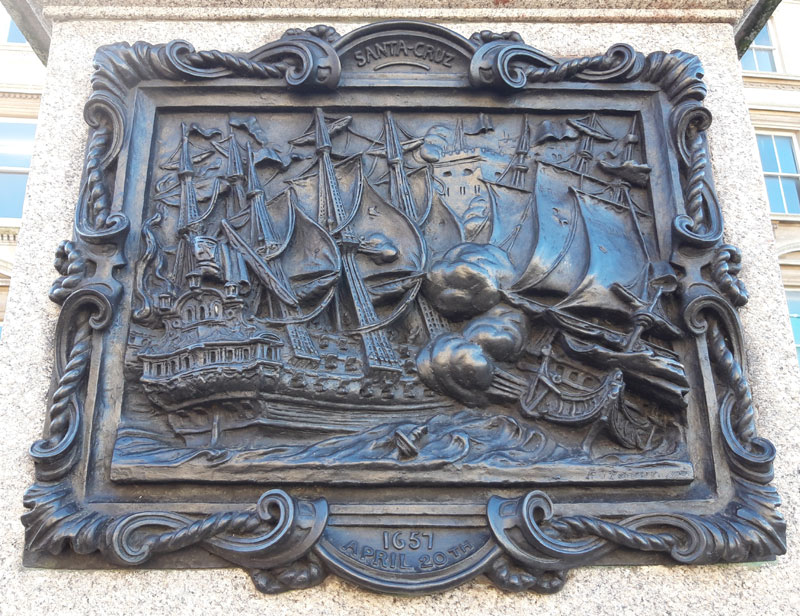
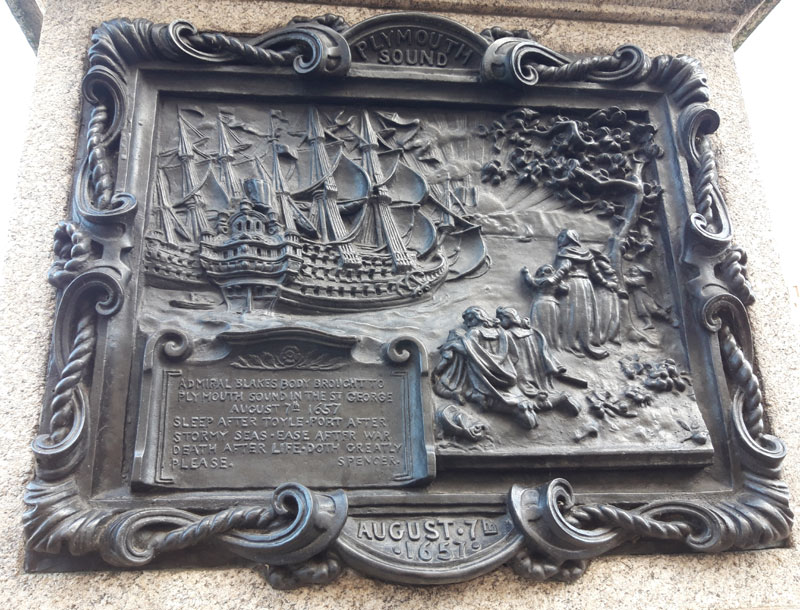
The second scene depicted is the brining home of Blake’s body into Plymouth Sound by the ship George, with a quaintly appropriate quotation from Spenser:-
‘Rest after toyle,
Port after stormy seas:
Death after life
Doth greatly please’
On the third occupied panel, the one which faces the Corn Exchange, appears an enlargement of the medal struck by the Commonwealth to celebrate Blake’s victory over van trump in 1653. The metal was struck in gold, but only three or four were known to have been issued, and only three present extent. One is in the possession of Her Majesty the queen, one is at the British Museum, and the third is owned by Wadham college, Oxford.
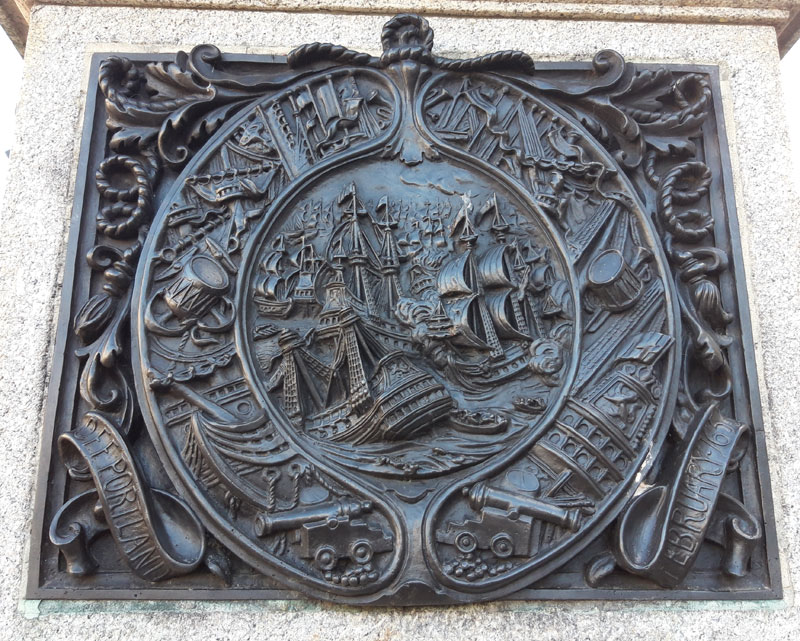
The pedestal on which the statue is mounted was the workmanship of Messrs W Bradfield and son of Eastover Bridgewater by whom it was constructed an embellished from Mr Pomeroy’s designs, supervised by the local architect of the work (Mr A. Basil Cottam), and is of Cornish granite.
The dimensions of the platform are 7ft 10in square and 8in in depth; those of the first base 4ft 7in quare and 1ft 6 1/2in in depth, whilst the second (moulded) base is 4ft 7in square and 3ft in depth. The die (on which the panels and inscription are affixed) is 2ft 11in square and 2ft 4 1/2in in depth; and on top of the die is a moulded cap 3ft 10in square and about 7ft in depth (the whole weighting not less than 9 tons 12 cwt).
The executive committee, consisted of the following:- Alderman F.C. Foster, chaiman; Captain M Burrows R.N., vice chairman; the Mayor (alderman T. Good), Alderman G.B. Sully; Alfred Peace, and H.W. Pollard; Messrs W.L. Winterbotham, E.H. Blake (Crewkerne), George Lovibond, Thomas Foster-Barham, Edward Trevor, W.L. Leng, W.A. Bell, A.H.A. Smith, Arthur Basil Cottam, F. Parr, R.Y. Foley, H. St.B. Goldsmith and W.T. Baker (Town Clerk).
The Celebrations
Lord Brassey was received at the Somerset and Dorset railway station, and a procession consisting of the members of the corporation, volunteers, and others, headed by the volunteer band, was formed at Saint John’s Hall, Monmouth Street, and passed through Monmouth Street, Eastover, Binford place, Dampiet Street, to Blake Street, where the tablet on the House in which the Admiral was born and lived was unveiled by Lord Brassey.
The procession then moved by St Mary Street to the Cornhill and took up its position in front of the Corn Exchange. Rain fell heavily and marred the effect of the demonstration, but in spite of this drawback the programme was adhered to.
The Earl of Cork, as Lord-Lieutenant of Somerset, introduced Lord Brassey, who was received with great cheering. He referred to the unavoidable absence of a very near and dear neighbour, Mr E.J. Stanley, and expressed sympathy which he was sure they all felt in the loss of his eldest son left tenant H.T. Stanley, in South Africa, and the deep regret that must be felt in the whole neighbourhood at their untimely end of so brave and promising a life. Lord Brassey represented a family which, perhaps, had contributed more to the wealth and prosperity of this country than any man who ever lived. Some of their greatest railroads were made by his father, and when Lord Brassey himself was a young man he joined his father in superintending some of those great and mighty works which were to be met with in most of their colonies and many parts of Europe. Then, Lord brassey took a deep interest in the welfare of the British sailor, and he did much for his welfare. (cheers)
Lord Brassey unveiled the statue by loosening the fastenings of national flags which enveloped it, and as they fell to the ground in a heap there were hearty cheers. His lordship said: it is a high privilege to come among you today to unveil the statue of Admiral Blake. It is the more gratifying if I may permit myself to believe that I owe the honour to that love of the sea and care for sailors which has been the main purpose of my life. (cheers). It needs no special knowledge or experience to appreciate how priceless is the value to England and to the whole British Empire of the services rendered by the great captains who have led our fleets to victory. (cheers). In that noble band Robert Blake, Admiral and general at sea, ranks amongst the most illustrious. Bridgwater is justly proud that it is the birth place of the naval hero to whom we are paying our tribute today. Here he followed the business of a merchant. Here he lived for many years, and here, in a more tranquil age, he might have ended his days unknown to fame. Another destiny was in store for Admiral Blake. His lot was cast in the stirring period of Cromwell and the Commonwealth. It called him forth from the retired life of a private citizen to be an empire builder, to be one of the makers of England. (cheers). When we survey the history of offices we do not look to the considerations we have in view in contemplating the career of the statesman. The responsibility for determining the justice of his country’s cause does not lie with the commanders of the national forces. Their part is to receive the call with unquestioning loyalty and to obey. We admire in these men their deeds of personal valour, and their self sacrificing devotion. We come here to pay our tribute to Admiral Blake, not as a statesman, but as a man of action, resolved in a grave crisis of his country’s history ‘to prevent foreigners from fooling us.’ I will not attempt a full story of Admiral Blake’s short but brilliant career at sea. It is the less necessary because we have all been reading an admirable narrative written by captain Montague Burrows, vice chairman of the Blake Memorial Fund. I pause for a moment to offer your grateful acknowledgments for the help he has given in connection with the ceremony of today. For the worthy commemoration of a naval hero captain barrows possessed exceptional qualifications. Who indeed could be so competent to treat of naval history as one, who, after a distinguished career in the Navy, left the quarterdeck, while still in the earliest prime of life, for the studying and teaching of history in the University of Oxford? (applause.) And now let me briefly recount the services rendered by Admiral Blake in his short but splendid career of eight years in command of fleets. His first successes were gained in conflicts with Prince Rupert. The next enemy was Holland. With assurance of your general ascent, and without distracting one iota from the fame of Admiral Blake, I cannot omit to say that we Englishman deeply regret are many wars with that gallant little nation, to whose aid we were indebted at a turning point in our history for the establishment of our revered and Protestant monarchy. The love of independence is no mean virtue in any people. We admire that quality in the Boers. It was their exclusiveness and arrogance which had made our relations with the Republic intolerable. (cheers). To return to the story of Admiral Blake. His battles with the Dutch were some of the hardest fights in naval history. Finer seaman than the Dutch, Admirals Van Trump, De Ruyter, and Evertsen, have never trod the deck. Through a prolonged struggle they offered a stubborn resistance. In the end Admiral Blake, by fearless courage and skilful conduct, established an undisputed supremacy for the British flag in the North Sea and the Channel. (cheers). The efforts of Blake were next directed to the suppression of piracy in the Mediterranean. Never in all the long interval since the Crusades had the squadrons of England visited those historic waters. Our hearts are a glow even today as we recall that when the flag of England was once more seen it was on a mission of mercy. At the bidding of Admiral Blake, Algiers, Tripoli, and Tunis were compelled to release their Christian slaves. The war with Spain was the last service on which Admiral Blake was engaged. His health was already broken. For a while he was compelled to leave the fleet of Cadiz, and to return to England. While still quite unfit for duty he embarked once more in March 1656. His second in command was Montague, general at sea, afterwards famous as Earl of sandwich. The British fleet was directed to intercept the treasure ships of Spain. They were met of Santa Cruz. The Spanish fleet was annihilated. It was the crowning exploits of Blake’s career. Worn by disease he sailed for England. He died as his ship was entering Plymouth sound. It would have been impossible on such an occasion worthily to narrate the deeds of Admiral Blake. Enough has been said to show that when it was resolved, in 1898, in the tercentenary of his birth in Bridgwater, to Raise a statue to the memory of Admiral Blake, late in the day, but most worthily recognition was being given to exalted merit. I have briefly referred to his victories at sea, and must mention, though I cannot dwell on the services of add more Blake in the manning an organisation of the Navy. It is not too much to say that he laid the foundation of that successful system upon which the Navy has since been administered. Two his conspicuous merits as a C officer add more Blake added moral qualities of the highest order. He was contemptuous of private gain. He was in the loftiest sense a patriot. (cheers). It is well that the lives of such men should be remembered. They stand forever as a shield and a buckler to their country. They are worth more to us today than whole fleets of ironclads. They inspire A wholesome respect for the prowess of British seamen. Their example fills those who come after with a noble ambition to emulate their deeds of glory Englishmen are caring for their Navy today as perhaps they never did before. In many a stirring strain the poets of our time, LED yesterday by Tennyson, and today by rude yard Kipling, are voicing the sentiment of the hour. I may fitly choose with a stanza from the pen of Henry Newbolt:-
Effingham, Grenville, Raleigh, Drake,
Here’s to the bld and the free,
Benbow, Collingwood, Byron, Blake,
Hail to the Kings of the Sea.
Admirals all for England’s sake,
Honour be yours and fame,
And honour as long as waves shall break
To Nelson’s peerless name.
Men of Bridgwater it has been on your part a right resolve that the name of Admiral Blake shall not be forgotten in the place of his birth. When Blake went afloat England had many rivals. In 8 short years he made her sovereign of the Seas. So may she through all time remain, protecting the defenceless, maintaining justice, and spreading from West to east and from pole to pole, the blessings of her religion and civilization. (loud cheers).
The chairman of the memorial executive committee (Alderman F.C. Foster) on behalf of the subscribers, presented the statue to the town, the mayor accepting it on behalf of the burgesses is, and referring to the family of the Admiral.
Colonel Blake, who was called upon, spoke briefly.
On the motion of the Bishop of Bath and Wells, seconded by the High Sheriff of the county (Mr R. Neville Grenville), a vote of thanks was accorded to Lord Brassey, who acknowledged the resolution. The national anthem was then played by the band.
At the invitation of the mayor there was a luncheon at the town hall, about 250 ladies and gentlemen sitting down, under the presidency of his worship who was supported by the mayoress, Lord Brassey, lady Brassey, the Earl of Cork, the Bishop of Bath and Wells, the Dean of Wells, the High Sheriff of the county, general H. Bethune Pattoc, Professor J.E. Odgers, Professor Montague Burrows, Professor J.K. Laughton, Mr. F.W. Pomeroy, Dr. Winterbotham, and Dr Blake Odgers.
The town hall had been effectively decorated, on the exterior in large characters appearing the patriotic sentiment ‘Country before all’. The extensive saloon was charmingly draped, and around the gallery at intervals were the names of our chief naval heroes.
After luncheon the loyal toast was honoured.
The Earl of Cork then gave the ‘Bishop, Clergy, and Ministers of all Denominations’, though he remarked that his researches failed to discover that Admiral Blake had much to do with bishops.
The Bishop of Bath and Wells Responded, and averted to the religious differences which existed in the time of Blake. Now, he said, they had also differences of opinion in the church, but he would rather see any differences of opinion than for people to be in the state of religious stagnation, and going comfortably to sleep. (hear, hear).
The High Sheriff of Somerset submitted ‘The Navy, Army, and Auxiliary Forces’.
Lord Brassey, in responding, said: in the absence of an officer of that noble service, I am proud to reply on behalf of the Navy for the enthusiastic reception of the toast.
Captain Everard, whose breast was covered with decorations showing the service he had seen, arose, and said that he was there as a naval officer. (cheers).
Lord Brassey: I am pleased to see so gallant an officer present, and I congratulate him upon his honourable career. (cheers). In the circumstances of the hour the Navy is deservedly popular. We have watched, and we have admired, the dauntless valour of our seamen in South Africa, their skill in gunnery, and their fertility of resources. (cheers). Our handymen have never failed in any service they have been called upon to perform. These recent events have strengthened the interest so strongly felt in the Navy of late years. The close of the Great War was followed by a long period of indifference to the condition of the Navy service. We had swept the seas; The broom was at the masthead. There was no enemy in the offing or even below the horizon. But now a change was passed up on the state of opinion. (cheers). That change was due to able writing in the public press, and, above all, to the effective demonstration of the influence of naval power on history, especially in the making of England, By such men as the late professor Seeley and Admiral Colomb, and my able professional writers such as captain Maban and Captain Burrows. (applause). It is well that the work was not taken in hand too late. If we had not possessed an indisputable supremacy at sea, the recent severe struggle in South Africa might not have ended without foreign intervention. The Navy saved us from that great risk. (cheers). I cannot sit down without a word of caution. It has been my life’s work to watch the state of the Navy, and to offer now and then a suggestion for its improvement. I should be wanting in my duty if I did not use whatever influence I may venture to claim with my countrymen in restraint of wars of aggression. We possess a noble empire. We can keep what we have got. Let us be cautious in adding to responsibilities already so vast as are those of the British Empire. Let us pursue an unselfish policy. Let us use our matchless power as to remove suspicion and win the confidence and the regard of nations of the world. (cheers).
General H. Bethune Patton spoke to the toast for the army.
Professor Montague Burrows proposed ‘the immortal memory of Blake’
‘Blake as a seaman’ was submitted by Professor J.K. Laughton.
Mr H. Newbolt spoke to this.
Mr J.P. Winterbotham (in the absence of Sir Walter Bessant) made some remarks on ‘Blake as a citizen’ and professor J.E. Odgers followed on the same topic.
Dr Winterbothan (secretary of the committee) proposed ‘the sculptor’ and Mr F.W. Pomeroy briefly responded.
With the exception of the rain which fell, the demonstration in honour of the great Somerset Shire heroes memory was highly successful. During the afternoon, as the rain had ceased, large numbers of persons inspected the statue, and expressions of admiration at the excellence of the work were heard on every side.
ADMIRAL BLAKE.
Great keeper of the empire of the seas,
Cherished by England’s sons eternally,
As one who in thy country’s need
Not Holland, nor Spain, nor any foe
Nor fleet of Spain thy fears could fright,
At Santa Cruz you taught the Don of Spain
That England’s power on sea should never wane.
So, whilst the love of country fires the heart,
Thou, who didst play in life the noblest part,
With Drake and Nelson shalt thou be
Undying kept in England’s memory.
—A. E. Tilling