Enmore Castle was designed and built between 1751 and 1757 by John Perceval, 2nd Earl of Egmont (1711-1770), an Anglo-Irish member of parliament in both the Irish and British parliaments. Perceval was educated at Westminster School and Christ Church, Oxford, and succeeded his father as Earl of Egmont in 1748. He became First Lord of the Admiralty in 1763 under George III, and under his tenure Captain James Cook took his first voyage around the world.


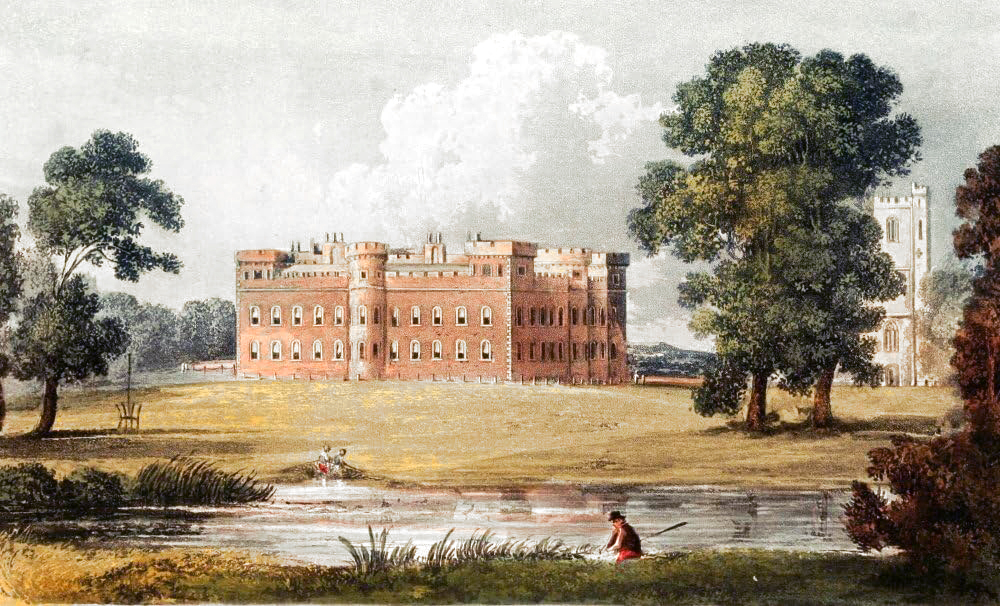
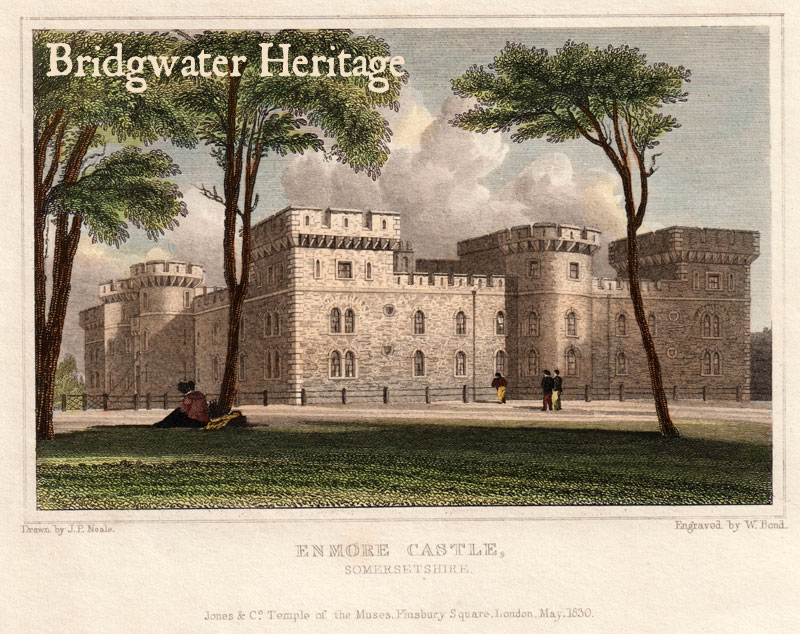
Egmont’s castle was built as a square around an internal courtyard, with four flush square towers on each corner, and three round turrets in the middle of three sides. The gatehouse, with its mullioned window and two side turrets, although heavily altered, was a remnant of the preceding moated manor house on the site, which had belonged to the Mallett family.
It was built in local red sandstone with pale yellow Bath Stone for the decoration. It was surrounded by a very deep dry moat. The stables below the house were accessed via the moat, keeping them hidden from view. There was even a tunnel between the house and the adjoining churchyard of St Michael. This was presumably to keep the castle residents somewhat dry when attending service, but could have just been for fun.
_(14577768460).jpg)
Enmore took its inspiration from older Perceval strongholds in Ireland, and was one of the first houses of the Gothic Revival, alongside the much more famous Strawberry Hill and Inverary Castle.[1] Although some commentators scoffed at the building (most notably Horace Walpole who built Strawberry Hill – someone, metaphorically, in a glass house throwing stones), it seems to have been more appreciated by others, with comments of it being ‘a splendid edifice’.[2] George Parker, the Bridgwater Historian, recalled it as ‘a noble building, standing on a gently-rising hill’.[3]
Plans of the Castle can be seen here. Likewise a plan of the castle drawbridge can be seen here.
John Perceval, 4th Earl of Egmont (1767-1835), grandson of the second earl who built the house, was forced to sell the castle on 29 October 1833, being heavily indebted. It was purchased by Henry Labouchere (1798-1868, later 1st Baron Taunton).[4] In the following January, advertisements were placed in the national press for the sale of the contents, sold to pay Egmont’s creditors, which included the extensive library, a gallery of paintings, ‘rare specimens of ancient tapestry’, as well as amour and state furniture.[5]
Furniture from Enmore Castle was sold over a series of days completing on 9 April 1834. Items included Queen Caroline’s death bed; a lounge chair with tambor work, black velvet covers and trimmed in silver, which had belonged to George II and George III, and an ivory box that had belonged to Queen Caroline.[6] A further sale of portraits, including Holbeins, Vandycks, Lely, Kneller, Vansomer, Dahl, Dobson, Rubens, and others took place on July 1837, although no mention of tapestries was made at this time.[7]
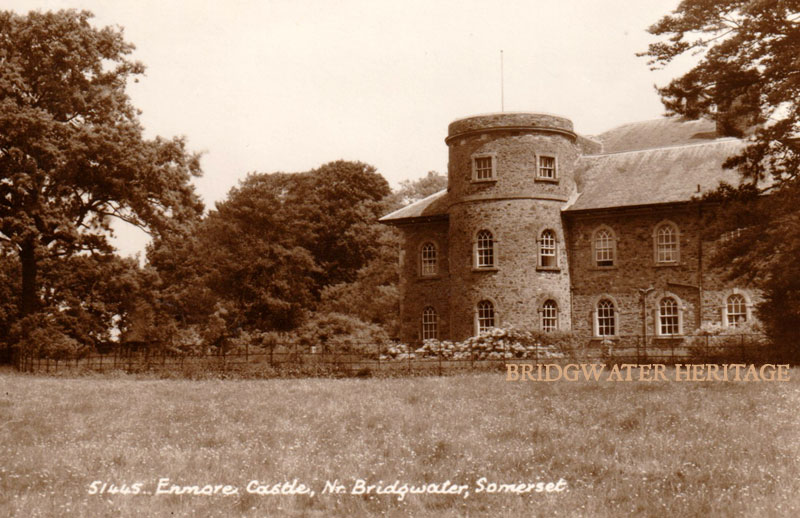
Following the first sale in April 1834, the castle was mostly demolished. That same month many materials were offered for sale, including fifty tons of lead, dowelled wainscot, oak and deal floorboards, 200 raised panelled doors with mortice locks, 200 windows with stone casings and sills, 50 carved chimney pieces, marble slabs, grates and fittings, 13 geometrical stone and oak staircases, and no less than 2 drawbridges. Mr Carver, the county surveyor seems to have assisted.[8] By November 1835 conversion to a ‘magnificent mansion’ had been completed.[9] In 1838 the freehold of the castle and its estate were put up for sale again, the castle now ‘a highly improved mansion’.[10] Nicholas Broadmead is usually credited with having purchased the property in 1833 and having demolished it, although he seems to have just initially have been the auctioneer employed for the sale. Broadmead only purchased the leasehold at least in 1836. In 1838 it was reported:
Enmore Castle, which in days of yore was inconveniently large, was purchased by Mr Broadmead two years ago, with its delightful domain, it has, by means of a clever architect, been re-constructed, and the Castle relieved of much of its unnecessary appendages – indeed it is so reduced in size, that a moderate-sized family may recreate there without the fear of being over-housed. George Robins proclaims it as the certain abode, at the approaching election, of the MP for Bridgwater or Taunton’.[11]
Broadmead seems to have kept some of the castle furnishings. Several Windsor chairs survive from the castle, and a detailed history of them can be read here. Two more chairs are mentioned here. The castle’s rent table was recently put up for auction, see here.
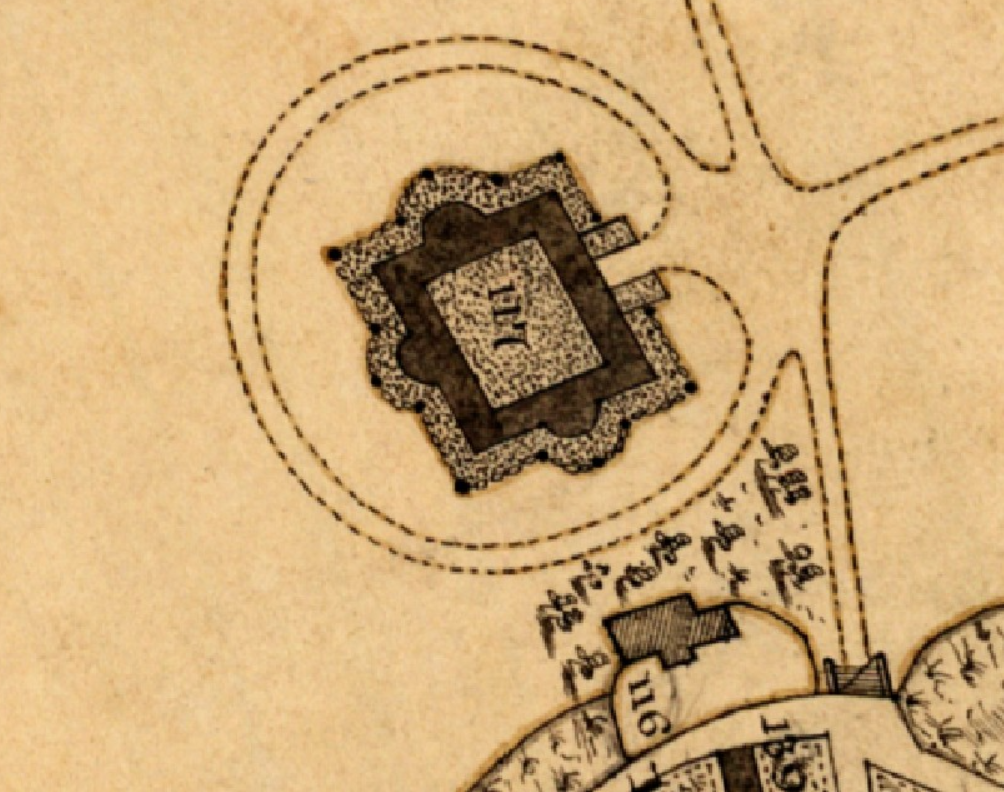
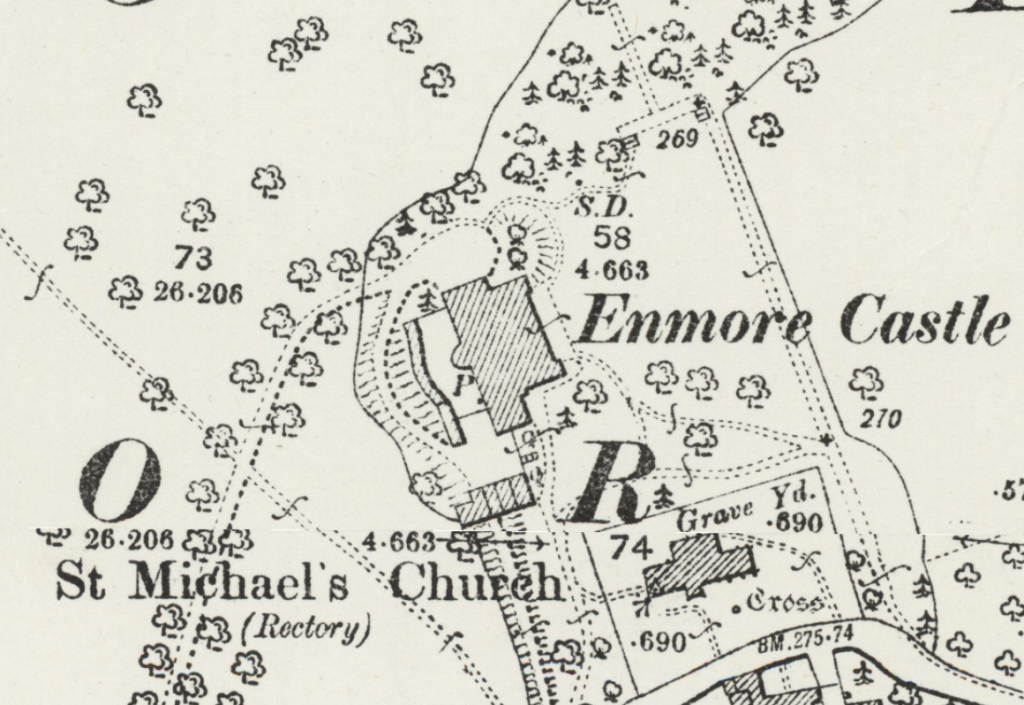
The Town Hall Tapestries
At the sale of furnishings of Enmore Castle three tapestries were purchased by Alderman John Chapman of Hamp House and in 1836 he presented these to the town of Bridgwater. They were used to decorate the Grand Jury Room in the Town Hall, which later became Council Chamber.[12] Chapman was an advanced age by this time, and in a meeting that year he declared that ‘for 70 years he had been anxious to promote the welfare and prosperity of the town’.[13]
Shortly before 1942 a Mr H.C. Marillier inspected the tapestries and described the three as upright in shape, in good condition, probably woven in Brussels, and forming part of a late sixteenth or early seventeenth century history of Alexander the Great.
He described the scenes as:
1. THE YOUTHFUL ALEXANDER BIDDING FAREWELL TO HIS FATHER, PHILIP, AND PREPARING TO RIDE BUCEPHALUS.
Philip wears a spiked crown, and is surrounded by a group of soldiers and other figures. The boy, advancing towards him, holds Bucephalus by the reins. The border is wide and showy: it has large sea-horses in the lower corners, a strapwork medallion in the centre of the side, and a blue cabochon at the top. The inscription is at the base in a long strapwork cartouche, flanked by cupids, and reads —
Alexander valedicit patrio Philippo ac avingit [sic foraccingit] se ad equitandum Bucephalum.
Alexander bids farewell to his father Philip and prepares himself to mount (or ride) Bucephalus.
This panel is cut and lacks the left side.
2. ALEXANDER PLACING A ROBE OVER THE BODY OF DARIUS.
Alexander is shown in the centre with spearmen around him. Below is a youth, holding an embossed shield. The horse is to the right. The borders are complete and the inscription reads
Darium caesum lucet Alexander ac proprio mantelo tegit.
Alexander weeps for the slain Darius and covers him with his own cloak.
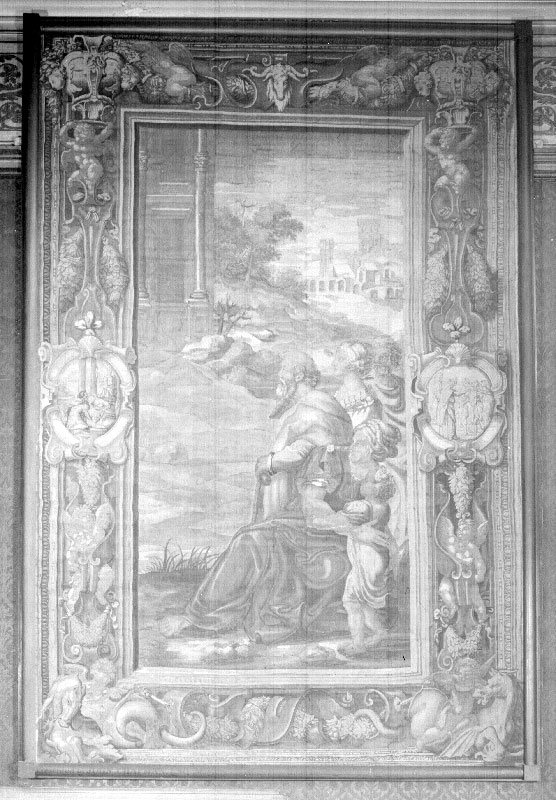
3. INCOMPLETE SCENE
Only a portion of the subject survives, and there is no inscription although there is a complete border. The scene represents a seated group of an old man looking up anxiously, and a woman comforting her child — possibly the family of Darius, in which case the panel may have belonged to the previous piece.[14]
Douglas Allan photographed the tapestries in 1959:
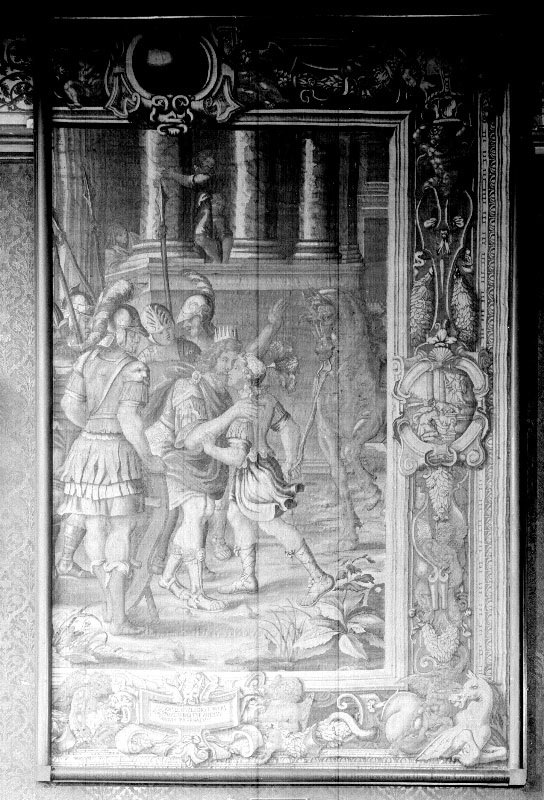
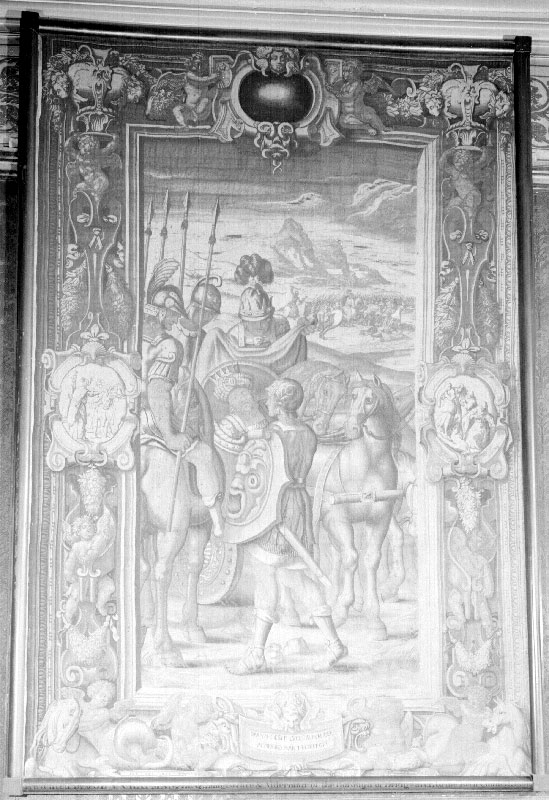
The tapestries will have been cut long before they came to the Town Hall. Most likely they had been trimmed to fit a certain room in a grand house, either Enmore Castle or by the previous owner. Tapestries were one of the greatest luxuries that could be purchased in the early modern period, some royals and nobles purchasing sets that could be worth as much as battleships. That Bridgwater’s grand jury room had them in the early nineteenth century would have spoken to the town’s prosperity and grandeur.
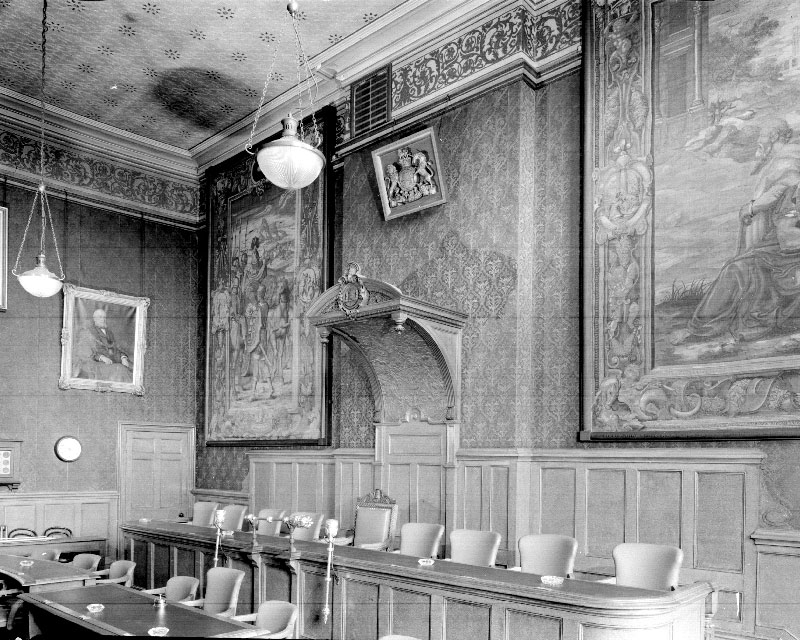
Although in 1942 the tapestries were described as in good condition, the same was not said 18 years later. In early February 1960 the council chamber was described as shabby. The last renovation had taken place in 1937 and the state of the room bought attention to the state of the tapestries.[15] Everyday dust would have settled on the pieces, but soot from the town hall’s fireplaces, and cigarette smoke will have accreted over time.
In early January 1964 the plan was to send the tapestries to the Victoria and Abert Museum in London for inspection by firms wishing to tender for their repair. They were in urgent need of repair, having sagged and an accumulation of dust was causing the fabric to rot. It was ‘strongly recommended that immediate action is taken’.[16] In April, Peter Young of the South West Area Museum Council also inspected the works, and identified them with the Gobelins workshops of tapestry making. Then the following month, Mrs K. Finch, a fellow of the International Institute for the Conservation of Historic and Artistic Works inspected the tapestries and reported that they dated from the late seventeenth century and that the minimum cost to clean them would be from £50 to £500 with repairs. The council was not prepared with the high cost that was needed at the time.[17]
The condition of the tapestries was again noted in early February 1968.[18] The Borough Librarian, Angus Dunn, wrote to Mr H, Schubart, Director of the City Art Gallery, Bristol, in which he mentioned certain council members wanting to dispose of the tapestries. He asked for Schubart’s oppinon of value and conservation options.[19] Later that month Schubart replied, passing the matter to Peter Young, who was now conservation officer for the Bristol City Art Gallery. Young suggested that valuation would depend on attribution of the tapestries to one of the famous tapestry manufacturers. He was less certain of the Gobelins attribution, suggesting further advice be sought, but he was confident they had been designed by Charles le Brun in 1663 for the Gobelins factory. However, even if the pieces were pirated copies they would still be valuable. Young indicated that the tapestries should be cleaned, which would bring out their vivid colours. They could then either be kept, or sold at a better price.[20] Dunn forwarded the advice to Mrs Irene Y. Tester, one of the councillors opposed to the tapestries’ disposal. Dunn suggested that parts of the advice could be republished in the Bridgwater Mercury to support their argument for keeping the pieces.[21]
About this time the following article appeared in the Bridgwater Mercury:
TAPESTRIES FOR MUSEUM?
Council Chamber “heirlooms”COUNCILLOR Fred Harris has told Bridgwater Town Council that they should hold a public referendum before taking any decision about the future of three large tapestries which hang in the council chamber. A recommendation from the Commerce and Development Committee asked the Council to consider the advisability of disposing of the tapestries. But the Chairman (Alderman B. M. Davis) pointed out that this was to give councillors the opportunity to make their views known.
The tapestries, approximately 20ft. by 10ft., were given to the Town Council about 1830 by Alderman John Chapman. They are understood to have been copied from the originals which hang at Enmore Castle.
Councillor Mrs. Doris Squibbs said that she would not like the Council to dispose of the tapestries which she regarded as one of the features of the Council Chamber, even if they were not particularly valuable.When council last valued three years ago the estimate was £1,240.
“Beautiful”
And Councillor Mrs. Margaret Rees felt they were “absolutely beautiful” although she appreciated that other people might not agree. Yet she would rather see them properly cared for than left to rot in the Council Chamber.
The Council could have one of the tapestries cleaned, but if this proved that it would be beyond its resources to have all three properly restored, they could be sold to someone prepared to undertake the necessary work.
It was doubtful if many other towns in the country could match the tapestries which were very fine copies, added Councillor Mrs. Rees.
Alderman E. J. Davies thought the tapestries would look out of place in any modern Council Chamber. But the Mayor (Councillor Clifford Harris) said that one of the finest tapestries in the country was hung in the new Council Chamber at Coventry and certainly did not look out of place.
Councillor Fred Phillips said that the Council owned many items which were kept in store because there was no room to display them to the public. He felt it would be better if the tapestries went to a museum where more people would have the opportunity to look at them.
Right to dispose?
Proposing that the council should dispose of the tapestries to a museum Councillor R. J. Newcombe said, “If we want to make this Council Chamber more cheerful they will have to go.”
But Alderman E. J. Davies suggested that as the tapestries were apparently a gift the council should first discover whether it had any right to dispose of them.
Alderman Mrs. Davis said that it would cost £400 to have the tapestries cleaned. And this figure did not include any additional sums for taking them down, transporting them to London and any restoration found to be necessary.
This could mean that the council would be faced with a bill for between £800 and £900 to have the tapestries properly restored.
Deferred
The Mayor pointed out that the Town Clerk (Mr. John Turner), was assured and expressed hope that the Council would not come to a hasty decision.
After voting on two propositions and two amendments the Council agreed to do nothing about the tapestries until such time as the Council Chamber was decorated.
And a recommendation from a committee that the Council Chamber should not be decorated at the present time was also accepted.
But the Council agreed to the purchase of a new carpet and have the Council Chamber chairs recovered.
A year passed with no action. On 5 March 1969 a decision was made: the Town council authorised the sale of the tapestries, following advice of the Town Clerk, Mr John Turner. The decision had been made following news that the Bristol City Art Gallery would be unable to clean the tapestries. The Royal School of Needlework has also said they could not take on the work. Given the difficulties and delays, sale of the tapestries at Southeby’s was thought the best way of proceeding, then some other suitable work of art be purchased for display – keeping to the spirit of the original gift ‘without the embarrassment of repairs and maintenance’.[22]
In the end, auction was not the fate of the tapestries. By 1 April 1969 the Town Council were offered £1000 for the tapestries, which they promptly accepted two days later.[23] On 11 April 1969, the three tapestries were paid for and safely removed by Londoner, Mr Peter Lodge ‘despite fears they would fall to bits when taken down’. He apparently removed the tacks pinning them to their frames, folded them up and took them away in a taxi. It was found that the 1936 renovations had just worked around the tapestries without taking them down.[24]
Miles Kerr-Peterson 1 March 2026
Compiled with notes kindly provided by Neil Squibbs – marked ‘Squibbs Collection’ in the notes below
[1] Tim Mowl, ‘’Against the Time in Which the Fabric and Use of Gunpowder Shall Be Forgotten’: Enmore Castle, Its Origins and Its Architect’ in Architectural History, 1990, Vol. 33 (1990), pp. 102-119.
[2] English Chronicle and Whitehall Evening Post, 16 January 1836.
[3] George Parker, The Ancient History of Bridgwater and Its Neighbourhood; Also Poems Connected Therewith (1877), 31.
[4] Dorset County Chronicle, 12 September 1833; Morning Herald (London) 15 January 1836; London Courier and Evening Gazette, 19 April 1838.
[5] Taunton Courier and Western Advertiser, 22 January 1834.
[6] Taunton Courier and Western Advertiser, 9 April 1834.
[7] Town and Country Advertiser, 2 July 1834.
[8] Town and Country Advertiser, 16 April 1834.
[9] Sherborne Mercury, 9 November 1835.
[10] Sun (London), 16 June 1838.
[11] Wiltshire Independent, 26 April 1838
[12] Devon and Somerset News, 1 March 1883.
[13] Admittedly, he said the best way he thought of doing so was opposing the Tories and supporting the Liberals. True Sun, 11 October 1836.
[14] Notes and Queries for Somerset and Dorset, vol. 23, 1942, question no. 147.
[15] Taunton Courier, 6 February 1964.
[16] Taunton Courier, 4 January 1964.
[17] Taunton Courier, 2 May 1964; Bristol Evening Post, 6 May 1964; Squibbs Papers: Letter, Town Clerk to Angus Dunn, borough librarian; 27 April 1964: Memo, Angus Dunn to Town Clerk, 28 April 1964:
[18] Western Daily Press, 8 February 1968.
[19] Squibbs Papers: Letter, Angus Dunn, wrote to Mr H, Schubart, 12 February 1968.
[20] Squibbs Papers: Letters, H, Schubart and Peter Young to Angus Dunn, 21 February 1968; Angus Dunn to Mr H, Schubart, 12 March 1968.
[21] Squibbs Papers: Memo, Angus Dunn to the Town Clerk, 27 March 1968.
[22] Bristol Evening Post, 4 March 1969; Western Daily Press, 4 March 1969.
[23] Bristol Evening Post, 1 April 1969; 3 April 1969.
[24] Bristol Evening Post, 11 April 1969; Wester Daily Press, 11 April 1969.